AI Clinic Management Software for Homeopathy Doctors in India (2026 Guide)
AI clinic management software helps homeopathy doctors manage patients, appointments, case records, prescriptions, billing, and AI-assisted workflows in one platform.
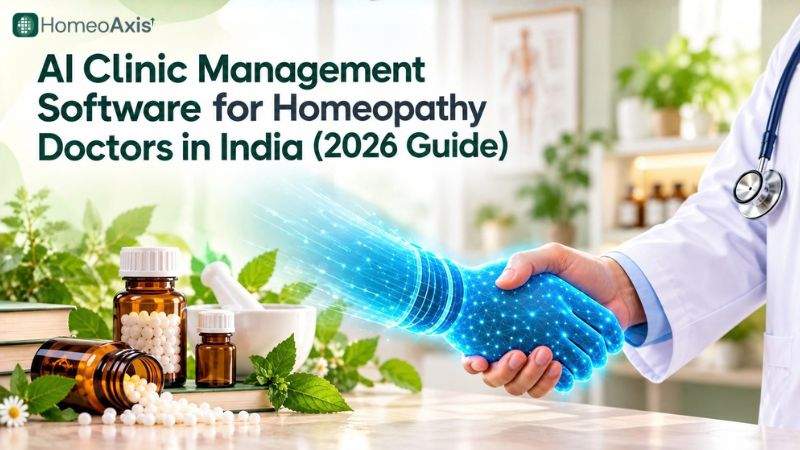
AI clinic management software helps homeopathy doctors manage appointments, patient records, case history, prescriptions, billing, follow-ups, and clinic operations from one platform, while AI can assist with selected clinical and administrative tasks. For homeopathy practices, the software becomes more useful when it also supports specialty-specific requirements such as repertory, materia medica, potency management, case analysis, and medicine workflows.
HomeoAxis is our product. We have included it in this guide alongside criteria you can use to evaluate any AI clinic management platform, including ours.
What Is AI Clinic Management Software?
AI clinic management software combines everyday clinic-management tools with AI-assisted features that can organize information, automate repetitive work, and support selected clinical workflows.
Traditional clinic management software can handle appointments, patient records, billing, prescriptions, and communication. An AI-powered clinic platform can add features such as structured case analysis, similar-case retrieval, formula discovery, analytics, and other forms of decision support.
AI should support a doctor's work, not replace professional judgment. Our AI features are designed as decision support, and the doctor remains responsible for reviewing the output and making the clinical decision.
For a homeopathy practice, useful capabilities can include:
Patient and case history management
Repertory and materia medica
AI-assisted case analysis
Appointment scheduling and reminders
E-prescriptions
Billing and payments
Medicine and pharmacy management
Patient portal
Follow-up management
Clinic analytics
Multi-doctor and multi-clinic management
How Does AI Help With Homeopathy Case Records?
AI can help structure case information, retrieve similar cases, and provide decision-support information during consultation.
Our AI Case Analysis structures the case, suggests remedies with confidence scores, retrieves similar cases, performs whole-patient constitutional matching, and supports formula-discovery research. It is built into the consultation workflow rather than functioning as a separate chatbot.
For clinic-mode AI, the learning can be restricted to the clinic's own anonymised cases. Our privacy policy specifies that the AI processing service receives structured case data for doctor-initiated AI features, while patient names, identifying numbers, and free-text narrative fields are stripped before transmission.
The AI output is not a clinically validated prediction and can be wrong. A confidence score represents the system's relative confidence in its generated result; it should not be interpreted as a probability of cure or treatment success.

Can AI Help With Appointment Scheduling and Reminders?
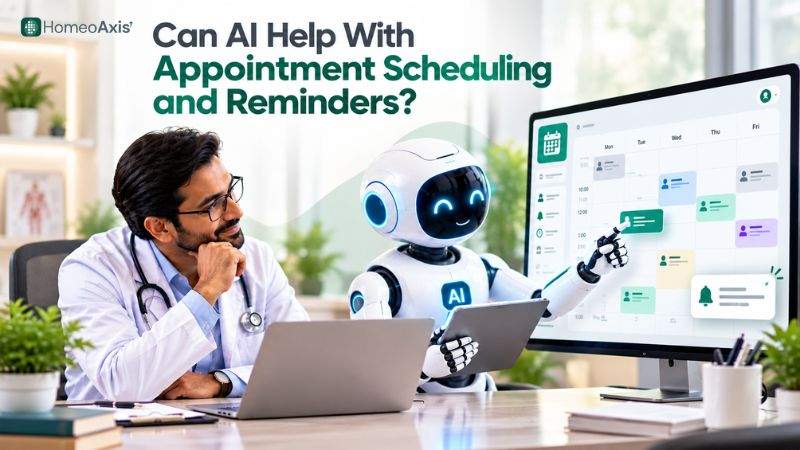
Appointment automation can reduce manual work by connecting online booking, doctor availability, reminders, rescheduling, and no-show tracking in one system.
These functions should not automatically be described as AI. Online booking and reminders are primarily automation features unless an AI component is specifically involved.
HomeoAxis provides online booking, multi-doctor scheduling, and automated reminders 4 hours and 30 minutes before an appointment through WhatsApp and SMS.
For a small clinic, this can reduce repetitive confirmation calls and messages while keeping appointment information organized.
How Does Digital Case Management Work?
Digital case management keeps patient and consultation information structured, searchable, and available for future visits, while AI can add assistance to selected parts of that workflow.
HomeoAxis provides a homeopathic EMR with structured case-taking fields covering areas such as chief complaint, generals, thermal state, thirst, sleep, bowel, mind, modalities, and family history. Patient records can also contain documents and other attachments.
The AI component is separate from basic record storage: when a doctor initiates an AI feature, structured case data is processed for the relevant AI task, while patient names, identifying numbers, and free-text narrative fields are stripped before transmission.
This is useful during follow-ups because doctors can review previous consultations, prescriptions, and case information from the same patient record.
Why Do Repertory and Materia Medica Matter in Homeopathy Software?
Repertory and materia medica features matter when doctors use these resources as part of their homeopathy workflow because they keep repertorisation and reference work closer to the consultation.
HomeoAxis uses the open OOREP “publicum” repertory with classic Kent-style grades (1–3). It supports manual repertorisation inside the consultation, and the repertory also feeds the AI case-analysis workflow.
When evaluating this feature, doctors should check:
How quickly rubrics can be searched
Which repertory is included
Which materia medica references are available
How repertorisation results are displayed
Whether results remain connected to the patient case
Whether results can flow into the prescription workflow
The current HomeoAxis documentation specifically identifies OOREP “publicum” as its repertory. It does not state that commercial repertories such as Synthesis or Complete are included. Doctors who depend on those repertories should verify compatibility before choosing a platform.
OOREP itself is an open online repertorisation system with multiple repertories and materia medica resources; the “publicum” repertory is derived from Kent.
What Homeopathy-Specific Features Should Doctors Look For?
A homeopathy-focused clinic platform should handle specialty-specific clinical details while also managing everyday administrative work.
What Is Medicine-Name Masking?
Medicine-name masking allows a doctor to hide the actual remedy name from a patient-facing prescription or invoice while keeping the underlying medicine record unchanged.
This can be useful when doctors want to protect proprietary formulas or dispensing practices while maintaining the complete internal record.
How Does Potency Progression Work?
Potency management lets doctors record and review the potency used for a medicine across different consultations and complaints.
For example, a patient's prescription history may show 30C during one consultation and 200C or 1M during another. The purpose is to keep the prescribing history organized; the software does not independently determine the correct potency.
What Are Similar-Case Retrieval and Constitutional Matching?
Similar-case retrieval helps doctors find relevant previous cases, while constitutional matching compares whole-patient case information as part of AI-assisted analysis.
Our AI Case Analysis includes similar-case retrieval and whole-patient constitutional matching within the clinical decision-support workflow.
What Is Formula Discovery?
Formula Discovery AI identifies recurring remedy combinations from clinic case data and can support research into patterns within the practice.
Our Formula Discovery feature can detect remedy combinations from clinic case data and generate research outputs. Clinic-mode AI can restrict learning to the clinic's own cases.
These outputs are research and decision-support tools. They are not proof that a particular formula will produce a particular clinical outcome.
What Does a Typical Day Look Like With AI Clinic Management Software?
An integrated clinic system can connect registration, consultation, prescription, billing, medicine dispatch, and follow-up without requiring staff to repeatedly enter the same information.
Consider a patient with a 10:00 AM appointment.
Before the consultation: The patient books an available slot online and receives automated appointment reminders.
During consultation: The doctor opens the existing patient record, reviews previous consultations, and records the current case.
Case analysis: If the doctor uses AI Case Analysis, the system can structure the case and provide similar-case or remedy-related decision support for review.
Prescription: The doctor creates an e-prescription with the selected medicine, potency, dosage, and follow-up details.
Billing: Consultation and medicine charges can be handled within the billing workflow.
After the visit: The patient can access relevant information through the patient portal, while configured reminders and notifications continue after the consultation.
The exact workflow depends on the clinic's configuration and plan.
What Are the Benefits of AI Clinic Software for Small Clinics?
For small clinics, AI clinic software can reduce repetitive administrative work while keeping patient records, appointments, prescriptions, billing, and follow-ups organized in one system.
A solo doctor may have the same person handling reception, appointments, patient communication, billing, and records. Bringing these activities into one platform can reduce the need to switch between multiple applications.
As a practice grows, requirements may include:
Multiple doctors
Multiple clinic locations
Staff permissions
Patient portals
Pharmacy management
Analytics
Lead management
Online patient booking
HomeoAxis currently provides multi-clinic support, role-based access, patient portals, analytics, lead management, and public doctor and clinic profiles. The current feature page lists 32 modules and 140+ features.
Can a Clinic Management Platform Help Patients Find a Doctor?
Yes. Some clinic platforms combine practice management with public doctor and clinic profiles, allowing patients to discover a practitioner and book an appointment online.
HomeoAxis includes public doctor and clinic profiles, a directory, online booking, and lead-management features.
This gives clinics a digital entry point for both existing patients and new enquiries.
How Should Doctors Evaluate AI, Privacy and Data Security?
Doctors should check what patient data is collected, how it is processed, who can access it, where it is stored, how long it is retained, and what happens when the clinic stops using the platform.
Our privacy policy identifies the clinic as the data controller for patient information and HomeoAxis as the data processor. It specifies that:
All traffic is encrypted in transit using TLS 1.2+.
OAuth refresh tokens, payment credentials, and other secrets are encrypted at rest using AES-256-CBC.
Patient portal authentication uses hashed session tokens.
The database is isolated in a private network.
Multi-tenant patient data is scoped by organisation ID.
The encryption claim should therefore be understood specifically: traffic is encrypted in transit, while specified credentials and secrets are encrypted at rest. The policy does not state that every item of patient data is individually encrypted at rest.
Our primary servers are in India. Some third-party services, including Google, Sentry, and Razorpay, may process data in other countries.
For account closure, patient records and clinical data remain available while the account is active. Clinics may export their data for 30 days after account closure, after which the data is deleted within 90 days, except where Indian medical-record retention requirements require longer retention.
Read the HomeoAxis Privacy Policy
India's Digital Personal Data Protection Act, 2023 provides the legal framework for processing digital personal data. Using clinic software does not automatically make a clinic compliant; the clinic and provider still need to understand their respective responsibilities.
Digital Personal Data Protection Act, 2023 — Ministry of Electronics and Information Technology
Is HomeoAxis ABDM or ABHA Integrated?
No. HomeoAxis is not ABDM/ABHA integrated today.
Clinics that specifically require current ABDM or ABHA connectivity should therefore consider this requirement before choosing the platform.
Ayushman Bharat Digital Mission — Official Website
Does HomeoAxis Work Offline?
No. We don't offer a dedicated offline mode.
HomeoAxis is a cloud-based platform, so clinics with unreliable internet connectivity should consider this requirement before implementation.
How Much Does Homeopathy Clinic Software Cost in India?
The full HomeoAxis clinic-management Software platform currently starts at ₹2,399 per month when billed annually, while the ₹1,599 annual-billing SSR Profile is designed for a clinic and doctor profile rather than the complete clinical platform.
SSR means Server-Side Rendered. The SSR Profile is designed around the clinic and doctor profile, online visibility, directory listing, lead capture, and related digital-presence features.
As of September 2026, our pricing page lists:
Plan
Annual-billing price
Clinics
Doctors
AI tokens/month
SSR Profile
₹1,599/month
1
2
1,000
Solo
₹2,399/month
1
2
150
Growth
₹3,199/month
3
6
350
Chain
₹4,799/month
5
12
700
The listed annual prices reflect a 20% discount. Every plan includes a 14-day full-system trial from day one.
The current pricing page does not state a separate GST amount in the displayed plan information, so doctors should confirm the final invoice amount at checkout.
AI capacity also varies by plan, so doctors who expect to use AI features frequently should compare the published AI-token allowance rather than looking only at the monthly subscription price.
View current HomeoAxis pricing
How Long Does It Take to Set Up Clinic Management Software?
A cloud-based platform can simplify setup because the clinic does not need to maintain a traditional local server, but the actual migration time depends on the clinic's existing records and workflow.
HomeoAxis allows clinics to register, add doctors and staff, configure clinic details, and begin managing appointments, consultations, prescriptions, billing, and other workflows. The current platform also provides onboarding support.
For existing records, clinics can upload documents such as scans, PDFs, and voice notes as patient attachments. This should not be confused with automatically converting every historical paper record into structured digital patient data. Clinics with large legacy databases should confirm their specific migration requirements before switching.
Who May Not Be a Good Fit for HomeoAxis?
HomeoAxis may not be the right fit for every clinic, particularly when a practice has requirements that the current platform does not support.
Consider another solution if your clinic:
Requires ABDM/ABHA integration today.
Requires a dedicated offline mode.
Depends on a repertory other than the OOREP “publicum” repertory and needs that repertory integrated directly into the workflow.
Requires a specific materia medica library that is not included in the current HomeoAxis offering.
Needs a workflow that cannot operate reliably through a cloud-based system.
Being clear about these limitations helps doctors compare platforms according to their actual requirements instead of choosing software based only on the number of features listed.
For professional and regulatory information related to homoeopathy practitioners and education in India, doctors can refer to the National Commission for Homoeopathy, the statutory body responsible for areas including education, assessment, ethics, and registration.
National Commission for Homoeopathy — Official Website
How Should Doctors Compare Different Clinic Management Platforms?
The best way to compare clinic management software is to test each platform against the actual workflow, specialty requirements, data needs, and budget of the clinic.
Instead of judging platforms only by feature counts, compare them across these categories:
Category
What to check
Patient management
EHR, case history, family profiles and documents
Homeopathy workflow
Repertory, materia medica, potency and prescription features
AI
What AI actually does, what data it uses, and how outputs are reviewed
Appointments
Online booking, reminders, rescheduling and no-show tracking
Billing
Invoices, payments, refunds and pharmacy billing
Patient engagement
Portal, prescriptions, notifications and medicine requests
Privacy
Encryption, access controls, data processing and retention
Integration
ABDM/ABHA, payments, messaging and delivery services
Scalability
Doctors, staff, clinics and permissions
Internet requirements
Cloud access and offline availability
Pricing
Trial, monthly/annual cost and AI usage limits
A category-based comparison is useful whether you are evaluating HomeoAxis, a general EMR, a dedicated repertory application, or another homeopathy-focused platform. Some competing products may have stronger capabilities in areas such as ABDM integration, offline workflows, or specialist reference libraries, so those requirements should be checked individually.
Frequently Asked Questions
Is AI clinic management software safe for patient data?
Its safety depends on the provider's security architecture, access controls, encryption, data-processing practices, retention policies, and contractual safeguards. Our privacy policy explains how HomeoAxis handles patient information and AI-related processing.
Can AI replace a homeopathy doctor?
No. AI clinic software provides decision support, while the qualified doctor remains responsible for reviewing the information and making clinical decisions. Our AI Case Analysis is designed as decision support rather than autonomous prescribing.
Is HomeoAxis ABDM or ABHA integrated?
No. HomeoAxis is not ABDM/ABHA integrated today. Clinics that require this connectivity should consider it when comparing platforms.
Does HomeoAxis work offline?
No. We don't offer a dedicated offline mode. HomeoAxis is cloud-based and requires internet access.
Is cloud-based clinic management software useful for small clinics?
It can simplify centralized access and reduce local infrastructure requirements, but clinics should confirm internet requirements, security controls, backups, and vendor support before adoption.
Does homeopathy clinic software need repertory and materia medica features?
If repertory and materia medica are part of the doctor's workflow, having them integrated into the consultation can reduce the need to switch between separate applications.
Can AI suggest homeopathic remedies?
Some homeopathy-focused AI systems provide remedy-related decision support, but the doctor should review the output before making a prescription. A confidence score should not be interpreted as a probability of cure or treatment success.
How is HomeoAxis different from generic EMR software?
HomeoAxis combines standard clinic-management functions with homeopathy-specific features such as structured case-taking, repertory, materia medica, potency management, medicine-name masking, formula discovery, and AI case assistance.
Final Takeaway
AI clinic management software is most useful when it connects everyday clinic operations with practical AI assistance and specialty-specific workflows.
For homeopathy doctors, the evaluation should include more than appointments and billing. Repertory, materia medica, structured case history, potency management, AI-assisted case workflows, prescriptions, follow-ups, patient communication, privacy, scalability, and AI usage limits can all be relevant.
HomeoAxis is designed specifically for homeopathy practices and currently combines these areas in one cloud-based platform. Its feature set currently covers 32 modules, including patient management, appointments, prescriptions, billing, AI assistance, patient engagement, repertory, pharmacy, and practice-management workflows.
Author
Prashant Singh — CTO & Software Expert
Prashant Singh is the CTO of HomeoAxis and works on software systems for homeopathy clinic management, including patient records, clinical workflows, AI assistance, billing, integrations, and practice-management tools.