Author: Prashant Singh, CTO and Software Expert
AI homeopathy software uses artificial intelligence to organise case notes, extract symptoms and modalities, and surface remedy references for a practitioner to review. It supports documentation and analysis; it does not replace clinical judgement. Doctors should evaluate its accuracy, source references, patient-data practices and limitations before choosing a platform.
Artificial intelligence is creating new possibilities for homeopathy practice, from case-taking and repertorisation to materia medica research and clinic administration. However, not every tool labelled AI-powered offers the same capabilities. Some focus on repertory searches, others manage clinic operations, while newer platforms combine these functions with AI-assisted case analysis.
This guide compares the main types of homeopathy software, explains how AI is used, reviews available research and identifies what practitioners should check before selecting a platform.
What is AI homeopathy software?
AI homeopathy software uses artificial intelligence to process case information, identify symptoms and modalities, organise consultation notes, and surface relevant repertory or materia medica references. It helps practitioners review information and manage their workflow, but the final clinical assessment and decisions remain the practitioner's responsibility.
Traditional homeopathy practice software generally focuses on digital case records, repertories, prescriptions, appointments and patient management. AI-enabled platforms add capabilities such as natural-language symptom searches, automatic case-note extraction, consultation transcription and similar-case retrieval.
For example, a practitioner can enter a case history in ordinary language. An AI tool may identify the chief complaint, modalities, sleep patterns and other details, then arrange them into structured fields.
The practitioner must check the extracted information, correct errors and clarify missing details before using it in case analysis.
How is AI used in homeopathy practice?
AI can support several activities in a homeopathy clinic, particularly where practitioners need to organise large amounts of case information or search across reference material. Its usefulness depends on the quality of the underlying data, the software's design and the practitioner's ability to verify its output.
Common applications include:
Case-note extraction: Identifying symptoms, modalities and other details from written consultation notes.
Repertorisation assistance: Helping practitioners search for relevant rubrics using natural-language descriptions.
Remedy research: Finding remedy references and related information across available materia medica sources.
Similar-case retrieval: Locating comparable cases from an available case database for further review.
Consultation transcription: Converting spoken consultations into text that practitioners can check and organise.
Clinic administration: Supporting patient records, appointments, prescriptions, billing and follow-ups.
Practice analytics: Presenting operational information such as consultation activity and revenue patterns.
A 2026 narrative review in the International Journal of Research and Innovation in Applied Science explores potential AI applications in homoeopathy, including case-taking, repertorisation and clinical decision support. It also discusses developments in mainstream healthcare AI and their possible relevance to homoeopathy. These are potential applications, not proof that AI has established clinical effectiveness in homeopathy.
Read the 2026 review on AI in Homoeopathy.
Example: How AI can organise a homeopathy case
Consider an illustrative case note describing recurring headaches that become worse in a warm room and improve in fresh air.
An AI-assisted case-analysis tool may organise the information into:
Chief complaint: Recurring headache.
Aggravating modality: Worse in a warm room.
Ameliorating modality: Better in fresh air.
Additional information: Details that may need clarification during case-taking.
The practitioner can review the extracted information, correct any errors and identify missing details before proceeding with repertory research.
This example demonstrates how AI may help organise information. It is not a real patient case or evidence that AI can independently select the correct remedy.
Can AI recommend the right homeopathic remedy?
Not reliably. General-purpose chatbots can summarise symptoms and suggest remedies, but a 2026 study found that their suggestions often differed from a practitioner's initial recommendation and from each other.
In the Healthcare study, researchers used notes from 100 acute cases and tested four free, publicly accessible AI chatbots. The practitioner's initial remedy recommendation appeared somewhere in the chatbots' suggestions in 36.5% of cases on average and as the top recommendation in 20.8%. In 41% of cases, none of the four chatbots suggested the practitioner's initial remedy.
The study also found that repeating the same case information could produce different recommendations from the same chatbot. The research treated the practitioner's initial remedy as a reference point, not as proof of the clinically correct remedy. It tested general-purpose chatbots rather than every purpose-built homeopathy software platform.
The researchers collected the chatbot data between 21 May and 13 August 2025. They describe the findings as a snapshot, and the chatbot models may have since changed. The results should not be treated as a current performance test of every AI tool.
Read the 2026 comparative study in Healthcare.
The practical conclusion is that AI-generated remedy suggestions require professional evaluation. Practitioners should check the original case information, verify the relevant references and make their own decisions.
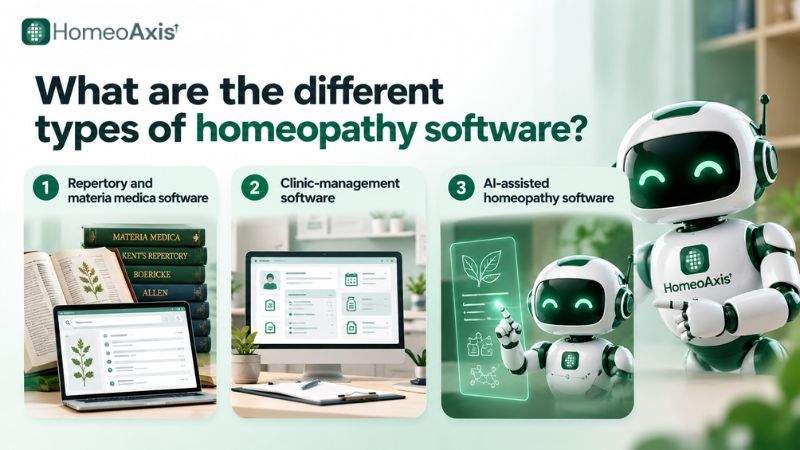
What are the different types of homeopathy software?
Homeopathy software generally falls into three categories: repertory and materia medica tools, clinic-management systems, and AI-assisted platforms. Some products specialise in one category, while others combine multiple functions.
Software category | Main purpose | Typical features | Examples |
Repertory and materia medica software | Researching symptoms, rubrics and remedy references | Digital repertories, remedy comparisons, materia medica libraries, repertorisation and case analysis | RADAR Opus |
Clinic-management software | Managing daily clinic operations | Patient records, appointments, prescriptions, billing, inventory, follow-ups and multi-clinic management | HomeoAxis and other clinic-management platforms |
AI-assisted homeopathy software | Supporting information extraction and research workflows | Semantic search, symptom extraction, consultation transcription, rubric mapping and AI-assisted case analysis | Similia and other AI-enabled platforms |
1. Repertory and materia medica software
Repertory and materia medica software helps practitioners search symptoms, review rubrics and compare remedy references. These tools are particularly useful when a practitioner needs access to large digital libraries rather than multiple printed books.
For example, RADAR Opus provides access to repertories, materia medica, keynotes, provings, journals and clinical cases. Its features also include search across reference material and specialised analysis modules.
This category is most relevant to practitioners who prioritise repertory depth, reference access and detailed remedy research.
2. Clinic-management software
Clinic-management software focuses on the administrative and operational needs of a homeopathy practice. It helps doctors maintain patient records, organise appointments, prepare prescriptions, manage billing and track follow-ups.
For clinics with multiple doctors or branches, additional requirements may include role-based access, shared or separate patient records, inventory transfers and branch-level reporting.
This category is useful when the main challenge is managing daily clinic operations rather than searching repertory references.
3. AI-assisted homeopathy software
AI-assisted platforms combine traditional homeopathy references or case workflows with features such as natural-language search, symptom extraction and consultation transcription.
Similia is one example. Its published features include repertory search, materia medica resources, semantic search, notes-to-rubrics extraction, transcription and AI case analysis.
AI-assisted software is relevant to practitioners who want help organising case information and locating references. However, the presence of AI features does not automatically establish clinical accuracy.
Which type of software should a homeopathy practitioner choose?
The right choice depends on the main requirement of the practice:
Choose repertory and materia medica software when reference libraries and detailed repertorisation are the priority.
Choose clinic-management software when patient records, appointments, billing and practice operations need improvement.
Choose AI-assisted software when natural-language searches, case-note extraction and research assistance are important.
Choose an integrated platform when you need several of these functions in one system.
Compare the actual features, reference libraries, licensing terms and data policies before selecting a platform.
How can AI support materia medica research and education?
AI can help practitioners and students search, organise and compare materia medica information, but the original source remains essential. Its main value is making reference material easier to explore, not replacing the study of classical texts or independent interpretation.
Materia medica research involves understanding remedy descriptions, characteristic symptoms, modalities and other information recorded across different authors. Searching several books manually can take time, especially when a practitioner wants to compare a particular symptom across multiple sources.
AI-assisted tools may support this process through:
Natural-language search: Finding relevant passages even when the search phrase differs from the wording used in the source.
Cross-reference searches: Locating related information across multiple materia medica sources.
Remedy comparison: Presenting selected remedy references together for further study.
Study assistance: Helping students organise topics, summarise source material and identify passages for closer reading.
Reference discovery: Finding relevant sections that practitioners can verify in the original books.
For example, a student researching a particular modality may use a semantic search tool to locate related passages across available materia medica sources. The student should then read the original passages, compare the authors' descriptions and understand the context rather than relying only on an AI-generated summary.
Platforms such as Similia list multiple materia medica sources and semantic search features. RADAR Opus also describes searching across its digital library of repertories, materia medica, journals and other reference material.
AI can make materia medica research more convenient, but students and practitioners still need to develop their own understanding of the original literature.

What should doctors check before choosing AI homeopathy software?
Doctors should evaluate the software's practical capabilities, data protection, reference quality and limitations before subscribing. A platform should explain what its AI features do, how patient information is handled and which functions are included in each plan.
Evaluation area | What doctors should check |
Case analysis | Can the software extract symptoms and modalities? Can practitioners edit the extracted information? |
Repertory access | Which repertories are included, and are premium sources charged separately? |
Materia medica | Which books and authors are available? Can users trace results to the original source? |
Remedy suggestions | Are suggestions supported by identifiable references? Can practitioners review the evidence? |
Confidence indicators | What do high, medium and low confidence labels mean? Are they validated or calibrated? |
Patient-data privacy | What information is collected, processed, stored or shared? |
AI learning | Can the clinic control whether its cases contribute to or use a shared learning pool? |
LLM provider | Which external language-model provider processes patient notes, if any? |
Data hosting | In which country or region is patient data hosted? |
Doctor controls | Can AI features be disabled for an individual doctor or clinic? |
Language support | Are Hindi and other regional languages supported for case entry, transcription and AI analysis? |
Offline access | Which records and functions remain available without an internet connection? |
Pricing | Are AI features included in the subscription? Are there monthly token or usage limits? |
A product comparison should also distinguish between features that are available now and those that are planned, experimental or subject to additional charges.
Is patient data safe when using AI homeopathy software?
Patient data is safe only when the software has appropriate security controls, clear data-processing practices and access restrictions. Doctors should understand where information is stored, which services process it, how long it is retained and whether it can be used for AI training.
Before entering patient information into an AI-enabled platform, check these areas:
Data collection: Understand what patient details the software collects and why.
Data processing: Identify whether consultation notes are processed by an external AI or language-model provider.
Data hosting: Check the country or region where patient records are stored.
AI learning: Understand whether patient information contributes to shared or model-learning processes.
Access control: Confirm that only authorised staff can access patient records.
Data retention: Review how long records and AI-generated information are retained.
Export and deletion: Check whether clinics can export records and request deletion when required.
Patient communication: Explain relevant uses of technology and AI to patients where appropriate.
The UK Society of Homeopaths' public statement on artificial intelligence says practitioners should critically evaluate AI output, inform patients where appropriate when AI contributes to professional work, and never allow AI to replace practitioner oversight. It also stresses patient privacy, informed choice and the need to protect confidential information from systems without appropriate safeguards.
India's Digital Personal Data Protection Rules, 2025 were notified in November 2025 and are being phased in over about 18 months. Some obligations are therefore subject to the notified implementation timeline. Clinics should check the latest official Ministry of Electronics and Information Technology notices for current requirements. This is general information, not legal advice.
Read the Government of India's PIB release on the DPDP Rules, 2025.
What are the limitations of AI in homeopathy?
AI tools can misunderstand case notes, omit important details or produce suggestions that sound convincing but are not adequately supported. Their output depends on the underlying data, model design and quality of the available references.
The main limitations include:
Incomplete case information: AI may not identify missing details or understand the full context of a consultation.
Incorrect extraction: Symptoms, modalities or other case details may be misinterpreted.
Unverified recommendations: Suggested remedies may not match a practitioner's assessment or the available source material.
Inconsistent results: The same input may produce different outputs, particularly with general-purpose chatbots.
Data privacy concerns: External processing can introduce additional privacy and security considerations.
Overdependence: Practitioners may give too much importance to automated suggestions if they do not independently review the output.
AI should therefore remain an assistive tool. Practitioners should verify extracted information, review original references and retain responsibility for clinical decisions.
Frequently asked questions
1. What is AI homeopathy software?
AI homeopathy software uses artificial intelligence to organise case notes, extract symptoms, search repertory references and support materia medica research. It can help practitioners manage information, but it does not replace professional judgement.
2. Can AI recommend the correct homeopathic remedy?
Not reliably. A 2026 study of four general-purpose chatbots found that their remedy recommendations often differed from practitioners' initial recommendations and from each other. The study did not establish which remedy was clinically correct or evaluate every purpose-built homeopathy platform.
3. What is the difference between repertory software and AI homeopathy software?
Repertory software primarily helps practitioners search symptoms, rubrics and remedy references. AI homeopathy software adds features such as natural-language search, symptom extraction, transcription and case analysis. Some platforms combine both types of functionality.
4. Can AI help with materia medica research?
Yes. AI-assisted search can help practitioners and students locate relevant passages, compare references and organise study material across available materia medica sources. Users should verify summaries and search results against the original books.
5. Is patient data safe when using AI homeopathy software?
It depends on the platform's security and data-processing practices. Doctors should check data hosting, external AI providers, access controls, retention, deletion options and whether patient information is used for AI learning before entering identifiable patient details.
6. Does AI replace repertorisation?
No. AI can assist with natural-language searches, rubric suggestions and information extraction, but practitioners should review the suggested rubrics and compare them with the original repertory. The final analysis remains the practitioner's responsibility.
7. Can students use AI homeopathy software for learning?
Yes. Students can use AI-assisted search to locate materia medica passages, explore repertory references and organise study material. However, they should read original sources and develop their own understanding instead of relying entirely on generated summaries.
8. What is the difference between homeopathy practice software and clinic-management software?
Homeopathy practice software may include repertories, materia medica, case analysis and prescription tools. Clinic-management software focuses on patient records, appointments, billing, inventory and operational workflows. Some integrated platforms offer both.
9. Does HomeoAxis offer AI-assisted case analysis?
Yes. HomeoAxis describes AI Case Analysis as a feature that extracts structured information from free-text case notes and supports case review. Its Features page states that the system extracts 21 structured fields. The platform also describes organisation-level learning controls, an Org-Mode AI option and a setting to disable AI for an individual doctor.
10. How much does AI homeopathy software cost?
Pricing depends on the software, available libraries, AI features, subscription model and usage limits. Some platforms offer free access to basic repertory tools, while advanced AI analysis or premium reference libraries may require a paid plan. Compare the total cost and included usage before subscribing.
Conclusion
AI homeopathy software can support case documentation, repertorisation, materia medica research and clinic workflows. However, AI-generated information is not automatically accurate, and current research does not justify treating general-purpose chatbot recommendations as clinically reliable.
The best software depends on the practitioner's requirements. Some doctors need extensive repertory and materia medica libraries, while others prioritise clinic management or AI-assisted case analysis. Evaluating features, source references, data protection, language support and pricing limits helps practitioners choose a platform that fits their workflow without giving up professional oversight.
Sources
Doherty et al. (2026). Comparing AI Chatbots to Live Practitioners of Homeopathy: A Comparative Retrospective Study. Healthcare, 14(7), 909. https://doi.org/10.3390/healthcare14070909
Maurya, R. B. (2026). Artificial Intelligence in Homoeopathy: Current Applications and Future Directions. International Journal of Research and Innovation in Applied Science, 11(5), 1002–1018. https://doi.org/10.51584/IJRIAS.2026.11050088
Thayyil, A. (2026). Artificial Intelligence as an Assistant in Homeopathy. Homeopathy, 115(2), 121–122. https://doi.org/10.1055/a-2710-8835
The Society of Homeopaths. Public Statement on Artificial Intelligence. https://www.homeopathy-soh.org/about-us/public-statement-artificial-intelligence-ai/
Government of India, Press Information Bureau. Digital Personal Data Protection Rules, 2025. Official PIB release
RADAR Opus. Official product and feature information. https://www.radaropus.com/
Similia. Official features and AI information. https://www.similia.io/features
Author
Prashant Singh is the Chief Technology Officer at HomeoAxis and writes about clinic technology, software and digital tools for homeopathy practices.