By Prashant Singh, CTO and Software Expert
Product Disclosure: The author is associated with HomeoAxis, a homeopathy clinic management software product. HomeoAxis is not a dedicated ambient AI medical scribe for multi-specialty hospitals.
An AI medical scribe for multi-specialty hospitals in India converts doctor-patient conversations into structured draft clinical notes for doctors to review and approve. It can support OPD consultations, IPD progress notes, ward rounds and discharge documentation. Before deployment, hospitals should evaluate clinical accuracy, Indian-language performance, patient consent, privacy requirements and EMR integration.
Key Takeaways for AI Medical Scribe
An AI medical scribe prepares draft clinical notes from consultation conversations.
Multi-specialty hospitals need department-specific templates and medical terminology support.
Some products also offer ICD-10 suggestions and prescription drafts, which clinicians must verify.
Hindi, English and relevant regional languages should be tested with real consultation examples.
Published research shows potential documentation-time savings, but results vary between tools and settings.
Hospitals should assess DPDP requirements, NMC record-keeping rules, patient consent and vendor data-processing arrangements.
A controlled pilot should measure clinical accuracy, including word error rate, as well as adoption, integration and total cost.
What Is an AI Medical Scribe?
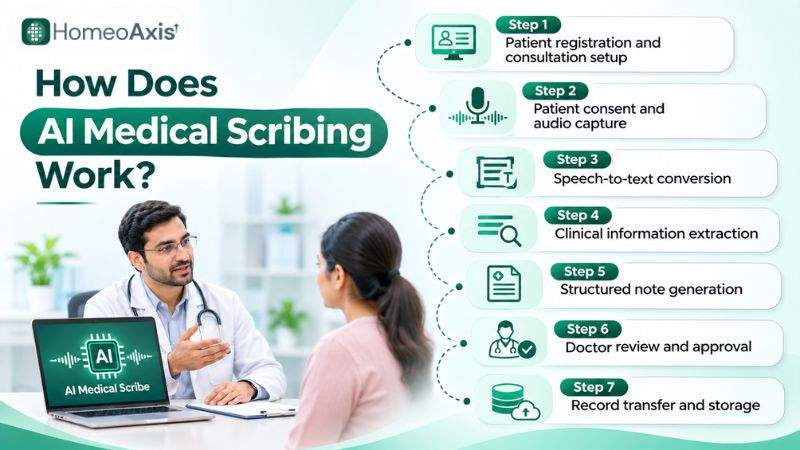
An AI medical scribe is software that uses speech recognition and language-processing technology to convert a doctor-patient conversation into a draft clinical note.
Instead of manually typing every detail during or after a consultation, a doctor can use the software to capture the conversation and organise relevant information into a structured format.
Depending on the product, it may prepare:
Patient history and presenting complaints
History of present illness
Review of systems
Examination notes
Assessment and diagnosis fields
Treatment and follow-up plans
SOAP-format clinical notes
SOAP stands for Subjective, Objective, Assessment and Plan. It is a common format for organising clinical documentation.
Some products also offer features such as ICD-10 code suggestions and prescription drafts. These should be treated as suggestions for the clinician to verify, not as confirmed diagnoses or authorised prescriptions.
An AI medical scribe is a documentation assistant, not an autonomous clinician. It should not independently diagnose a patient, decide treatment or issue an unreviewed prescription.
How Does AI Medical Scribing Work?
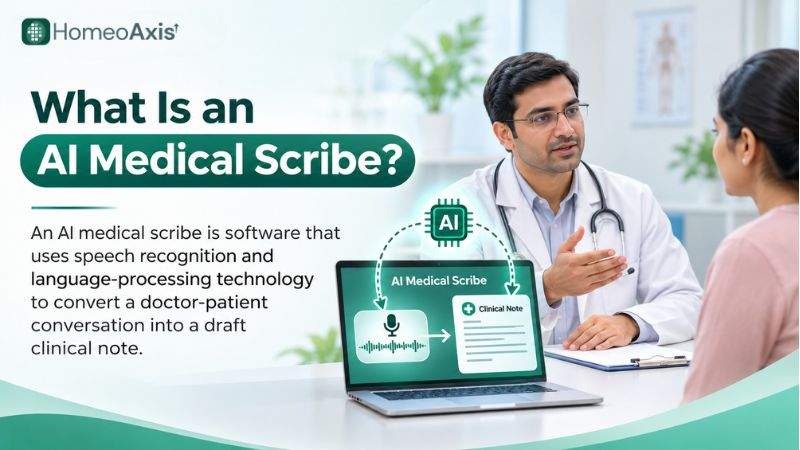
An AI medical scribe generally follows seven steps, from consultation recording to transferring the approved note into the hospital's record system.
Step 1: Patient registration and consultation setup
The patient is registered or identified in the hospital system. The consultation is associated with the correct patient, doctor, department and appointment.
Step 2: Patient consent and audio capture
The hospital explains the recording and documentation process and obtains consent according to its policy and applicable requirements. The software captures the consultation through an approved device or application.
Step 3: Speech-to-text conversion
Speech recognition converts the recorded conversation into text. Accuracy depends on audio clarity, background noise, accents, medical terminology and language support.
Step 4: Clinical information extraction
The AI system identifies relevant information, such as symptoms, duration, medical history and follow-up instructions. It should distinguish between information reported by the patient and findings entered by the doctor.
Step 5: Structured note generation
The system organises the extracted information into a selected format, such as SOAP or a department-specific clinical template. Depending on the product, it may also suggest diagnosis codes or prepare a prescription draft for clinician verification.
Step 6: Doctor review and approval
The doctor checks the draft, corrects errors, adds missing clinical details and approves the final note. Only the approved record should become official clinical documentation.
Step 7: Record transfer and storage
Where integration is available, the approved note is transferred to the hospital's EMR or Hospital Information System (HIS), subject to the hospital's access and approval controls.
AI medical scribe workflow
The AI creates a draft; the doctor reviews and approves it before it enters the official record.
Example: Hindi-English consultation and AI-generated SOAP note
Consider a fictional consultation in which a patient explains symptoms in Hindi and English.
Sample doctor-patient conversation
Patient: "Doctor, mujhe pichhle teen din se headache ho raha hai. Mostly evening mein pain badh jata hai. Kabhi-kabhi nausea bhi feel hota hai."
Doctor: "Pain kis side hota hai? Aur fever ya vomiting hui hai?"
Patient: "Mostly forehead area mein hota hai. Fever nahi hai, vomiting bhi nahi hui."
Doctor: "Koi existing medical condition ya regular medication?"
Patient: "Nahi, koi regular medicine nahi le raha hoon."
This is how the software might organise the information into a draft SOAP note:
SOAP section | Example AI-generated draft |
Subjective | Patient reports headache for three days, mainly in the forehead region, with increased pain during the evening. Occasional nausea is reported. Patient denies fever and vomiting. No regular medication reported. |
Objective | No examination findings or vital signs provided in the sample conversation. Doctor to enter examination findings and measured vitals. |
Assessment | Not specified in the sample conversation. The treating doctor must enter the clinical assessment. |
Plan | No treatment or follow-up plan stated in the sample conversation. The treating doctor must complete this section. |
The patient's response to the doctor's combined question is important. Although the doctor asks about existing medical conditions and regular medication, the patient only clearly states that they are not taking regular medication.
The AI should therefore record "No regular medication reported", not "No known medical conditions."
An incorrect draft would be:
"Patient has no known medical conditions and is not taking any medication."
The first statement is unsupported because the patient did not clearly answer the question about existing medical conditions.
This example demonstrates an important safety principle: AI should organise information that was actually provided, not invent missing examination findings, diagnoses or treatment decisions. The example is illustrative; a hospital's clinical team should check it before using it as a live documentation template.
Why Do Indian Multi-Specialty Hospitals Need AI Scribing?
Indian multi-specialty hospitals handle large numbers of consultations across departments, doctors and clinical workflows. Manual documentation can take considerable time, particularly when physicians must enter prescriptions, patient histories and progress notes into a Hospital Information System.
What does the Indian hospital workload look like?
An OpsTree case study describes a North Indian hospital network operating more than 17 hospitals with over 5,000 beds. According to the vendor, doctors in the network were seeing approximately 40–60 patients per day and spending 2–4 hours on daily administrative documentation.
The case study identifies several challenges:
Repetitive manual prescription entry.
Missing vitals, patient histories and dosage details.
Hindi-English code-mixed consultations.
Difficulty transcribing medical terminology accurately.
Meeting ABDM requirements for complete and auditable digital health records.
The hospital network is not named in the published case study. These workload figures are vendor-reported information from one deployment, not an independently established average for Indian hospitals.
Source: OpsTree hospital-network case study.
What does published research show?
Two studies provide useful evidence about AI scribe use in clinical settings. Their findings should be interpreted in the context of their study populations and settings.
Study | Setting and sample | Main result | Important limitation |
JAMIA study, 2025 | 45 physicians across 8 ambulatory disciplines at one academic medical centre, over 3 months | The scribe was used in 55.25% of encounters. Median time per note decreased by 0.57 minutes. The study also reported median daily reductions of 6.89 minutes in documentation time and 5.17 minutes in after-hours EHR time. | Single-centre quality-improvement study; usage varied between physicians. |
NEJM AI randomized trial, 2025 | 238 outpatient physicians across 14 specialties at one UCLA academic health system | Nabla users had a 9.5% reduction in time-in-note compared with the control group. DAX did not show a statistically significant reduction versus control. | One US academic health system; results differed between tools. |
The JAMIA study found a median reduction of approximately 34 seconds per note. It also reported reductions in daily documentation time and after-hours EHR time, which provide additional context beyond the per-note figure.
In the UCLA trial, note-writing time decreased by 41 seconds in the Nabla group and 18 seconds in the control group, giving an estimated difference of approximately 23 seconds.
The UCLA trial also reported that the scribes were used in approximately 30–34% of visits: 33.5% for DAX and 29.5% for Nabla. This indicates that availability of an AI scribe does not necessarily mean it will be used in every consultation.
The findings suggest that AI medical scribing can reduce documentation time in some settings. They do not establish a fixed time saving for every doctor, specialty or software product.
The UCLA trial also reported occasional clinically significant inaccuracies, including omissions and pronoun-resolution errors. Neither study establishes performance in Indian hospitals or validates Hindi-English and other Indian-language consultations.
Sources: JAMIA study by Stephen P. Ma et al. and NEJM AI randomized trial by Paul J. Lukac et al..
What do Indian hospital deployment examples show?
Indian healthcare technology providers have published case studies describing AI-assisted clinical documentation. These examples offer insight into possible hospital workflows, but their results are vendor-reported rather than independent clinical evidence.
OpsTree: AI-assisted documentation for a hospital network
OpsTree reports that its implementation reduced per-consultation documentation time from 3–5 minutes to under 1 minute. The case study also reports that doctors reclaimed 3–4 hours per day.
The described workflow covers OPD e-prescriptions, IPD progress notes and real-time transcription. It supports more than 23 prescription fields, including vitals, diagnosis, medication, investigations, referrals and clinical notes. The case study describes Hindi-English code-mixed speech support and physician confirmation of AI-generated records before submission to the HIS.
These reported time savings are substantially larger than the 0.57-minute median reduction in the JAMIA study. One possible explanation is that the workflows and baselines differ: the OpsTree example describes structured prescription entry in an Indian HIS, while the JAMIA study measured note-writing time in US ambulatory settings. This is an interpretation, not a proven explanation. Hospitals should establish their own baseline and measure actual results during a pilot.
Source: OpsTree hospital-network case study.
Wockhardt Hospitals: Speech transcription integrated with ClinicIQ
ElevenLabs reports that Wockhardt Hospitals integrated its Speech to Text API into ClinicIQ, Wockhardt's AI-assisted clinical documentation platform. ClinicIQ processes the transcription through its own AI pipeline to generate structured medical documentation. The vendor case study reports a 62% average improvement in consultation documentation coverage compared with the earlier smart-pen workflow, based on a pilot across multiple doctors. ElevenLabs supplies the speech transcription component, not the complete scribe platform. These performance figures remain vendor-reported results.
Source: ElevenLabs Wockhardt Hospitals case study.
Why is Indian-language support important?
Indian hospital consultations may include English, Hindi, regional languages and code-switching within the same conversation. A patient may explain symptoms in Hindi while the doctor uses English medical terminology.
Depending on the hospital's location and patient mix, the software should be tested with:
Hindi
Tamil
Telugu
Bengali
Marathi
Gujarati
Kannada
Malayalam
Punjabi
Odia
A vendor's general multilingual claim is not enough. Test medical terms, accents, mixed-language sentences, medicine names, numbers and patient names using representative consultations.
How Does It Support Different Medical Specialties?
An AI medical scribe should support the documentation requirements of each department rather than applying one generic note format to every consultation.
Medical specialty | Documentation details to evaluate |
General medicine | Presenting complaints, symptom duration, medical history, allergies, examination findings and follow-up instructions |
Orthopaedics | Affected side or laterality, injury history, pain location, mobility, examination findings and imaging references |
Paediatrics | Age, weight, growth details, caregiver-reported symptoms and weight-based dosing fields where clinically appropriate |
Gynaecology and obstetrics | Last menstrual period (LMP), relevant obstetric history, gravida and para details, pregnancy-related information and follow-up |
Dermatology | Lesion location, size, appearance, distribution, duration and relevant examination findings |
Cardiology | Presenting symptoms, relevant cardiac history, examination findings, investigation references and follow-up |
Neurology | Symptom onset, duration, affected side, neurological history and examination findings |
ENT | Affected ear, nose or throat, symptom duration, examination findings and relevant test references |
For hospitals with inpatient services, evaluate whether the software can also support IPD progress notes, ward-round documentation and discharge-summary drafts. These workflows may require information from multiple consultations, investigations and treatment updates, so hospitals should test how the system handles information from different sources and dates.
These are examples of information that a department may need to document. They are not instructions for an AI system to infer missing clinical findings.
Department leads and clinicians should review the templates before deployment to ensure that the fields match their actual documentation requirements.
AI Medical Scribe vs Dictation vs EMR Templates
An AI medical scribe, speech dictation tool and EMR template solve different documentation problems. An EMR stores and manages patient records, while an AI scribe helps prepare the clinical note.
Factor | AI medical scribe | Speech dictation | EMR templates |
Main purpose | Converts consultation conversations into structured draft notes | Converts spoken words into text | Provides predefined fields for entering information |
Context understanding | Attempts to organise conversation details | Usually transcribes spoken content | Depends on selected fields and user input |
Structured notes | Can generate formats such as SOAP | Usually requires additional formatting | Uses predefined sections |
Doctor involvement | Review and approval are required | Doctor edits and organises the transcription | Doctor enters or selects the information |
EMR role | May send approved notes to the EMR | Text is entered or copied into the record | Stores and manages the patient record |
Main limitation | May omit or misinterpret clinical details | May produce transcription errors | Can require repetitive manual entry |
The difference between an AI scribe and an EMR is important. An EMR or HIS maintains patient records, appointments and other hospital information. An AI medical scribe prepares draft documentation from a consultation. It may integrate with an EMR, but it does not automatically replace the hospital's record-management system.
What Features Should Hospitals Evaluate?
The best AI medical scribe for a hospital is not necessarily the one with the most features. It is the one that performs reliably within the hospital's clinical, technical and operational requirements.
1. Medical terminology recognition
Test the software with specialty-specific terminology, abbreviations, medicine names and commonly used clinical expressions.
2. Indian accent and language support
Evaluate transcription in Indian English, Hindi-English conversations and the regional languages relevant to the patient population.
3. Specialty-specific templates
The system should support department-specific documentation instead of forcing every doctor to use the same generic note format.
4. IPD, ward-round and discharge documentation
For hospitals with inpatient departments, check whether the product supports progress notes, ward-round documentation and discharge-summary drafts. Confirm whether it can distinguish new findings from information recorded during earlier visits.
5. ICD-10 suggestions and prescription drafts
Some products offer suggested ICD-10 codes and draft prescriptions. Treat these as optional features to evaluate, not as proof of diagnostic or prescribing accuracy.
Check whether the software:
Suggests codes without automatically confirming a diagnosis.
Shows the clinical information behind a suggested code.
Allows the doctor to reject or change the suggestion.
Prepares prescription drafts that the doctor can edit.
Requires the authorised clinician to confirm and sign the prescription.
The treating doctor must verify the diagnosis, medicine, dose, route, frequency and other prescription details before approval.
6. Doctor review and approval
Doctors should be able to edit, reject and approve generated notes. The system should distinguish between AI-generated drafts and approved records.
7. EMR and HIS integration
Check whether the software can transfer approved notes to the existing system through a supported API, FHIR interface or another secure integration method. Confirm patient matching, approval status, timestamps and error handling.
8. Access controls and audit history
Evaluate role-based access, user authentication and audit records showing who accessed, changed or approved a clinical note.
9. Data storage and retention controls
Understand where audio and transcripts are stored, how long they are retained, who can access them and what happens when the contract ends.
10. Performance and support
Assess response time, availability, integration maintenance, implementation support and the vendor's process for handling errors.
Examples of Indian AI medical scribe products
The following products publicly describe AI-assisted clinical documentation capabilities. This is a neutral list of examples, not a ranking or endorsement. Published features do not establish comparative accuracy or suitability for every hospital.
Product | Published features to evaluate | Integration or workflow information |
EkaScribe | Structured SOAP notes, clinical summaries, prescriptions, custom templates and multilingual support. | Its published information describes use alongside existing EMRs through a browser extension. |
MocDoc SenZ | OP consultations, IPD documentation, clinical notes, discharge documentation and dental consultations. | Its website describes integration with the MocDoc hospital and clinic management platform, with doctor review and approval. |
Patient Square | Structured SOAP notes, ICD-10 suggestions and prescription drafts. | Its product information describes a review-and-sign workflow. Discharge summaries are listed under broader platform capabilities. |
Information checked: 10 November 2026.
Hospitals should verify current availability, supported languages, pricing, integration scope, security arrangements and clinical performance directly with each vendor. A published feature list is not a substitute for a hospital-specific pilot.
Sources: EkaScribe, MocDoc SenZ and Patient Square.
Privacy, Consent and Compliance in India
An AI medical scribe processes sensitive consultation information. Hospitals should assess patient privacy, recording consent, data security, medical record requirements and vendor responsibilities before deployment.
What does the DPDP Act mean for hospitals?
The Digital Personal Data Protection Act, 2023 and the Digital Personal Data Protection Rules, 2025 establish India's framework for digital personal data processing. Their provisions have phased commencement dates.
The DPDP Rules were notified in the Gazette on 13 November 2025. Their commencement schedule is:
Rules 1, 2 and 17–21 came into force on 13 November 2025, the date of Gazette publication.
Rule 4, which covers Consent Manager registration, will come into force on 13 November 2026.
Rules 3, 5–16, 22 and 23 come into force on 13 May 2027.
Most obligations that affect hospitals, including those on consent and processing, begin in the May 2027 phase. Rule 4 mainly affects organisations that want to register as Consent Managers. It does not require ordinary hospitals to use a Consent Manager.
The commencement notification also phases the Act's provisions. The main data-processing obligations are scheduled for the eighteen-month phase. Section 44(2), which addresses the omission of Section 43A of the Information Technology Act, is also in that phase. Therefore, Section 43A and the SPDI Rules, 2011 remain relevant during the transition period.
Under the framework, the hospital will generally determine why and how patient information is processed and may therefore act as the Data Fiduciary. An AI scribe vendor processing that information on the hospital's instructions may act as a Data Processor. The actual roles depend on the arrangement and should be reflected in the contract.
Sources: DPDP Rules, 2025 and DPDP Act commencement notification.
What should hospitals check under NMC record-keeping rules?
The Indian Medical Council (Professional Conduct, Etiquette and Ethics) Regulations, 2002 include provisions relevant to medical records and patient confidentiality:
Regulation 1.3.1: Indoor patient records should be maintained for three years from the commencement of treatment.
Regulation 1.3.2: Requested medical records should be issued within 72 hours.
Regulation 1.3.4: Efforts should be made to computerise medical records.
Regulation 7.14: Doctors must maintain patient confidentiality, subject to the exceptions described in the regulation.
The NMC's 2023 notification placed the 2023 professional conduct regulations in abeyance and adopted the 2002 regulations with immediate effect. Hospitals should verify the latest NMC notifications and Gazette position before relying on this status for a compliance decision.
These provisions do not make an AI scribe automatically compliant. Hospitals remain responsible for appropriate medical record processes, confidentiality and access controls.
Source: NMC Code of Medical Ethics Regulations, 2002.
What about ABDM and NABH?
Hospitals participating in the Ayushman Bharat Digital Mission (ABDM) should evaluate relevant health-data exchange, consent and interoperability requirements. ABDM integration is not automatically necessary for every AI scribe deployment; it becomes relevant when the hospital participates in the ABDM ecosystem or needs the associated exchange capabilities.
The ABDM Health Data Management Policy provides guidance on privacy and data protection within the digital health ecosystem. Hospitals should also assess applicable interoperability specifications, including relevant FHIR implementation guidance.
NABH's hospital standards include an Information Management System (IMS) chapter. It is one of the ten chapters in the hospital standards. Hospitals should evaluate their AI scribe workflow against the applicable edition and requirements of their accreditation programme.
Sources: ABDM Health Data Management Policy and NABH official hospital standards.
How should patient consent be handled?
Hospitals should explain that the consultation may be recorded or processed by an AI documentation tool, why the information is being processed, how it will be used and who may access it.
The hospital should follow its legal advice and consent policy to decide how consent is obtained and recorded. Depending on the workflow, this may involve written or verbal consent, but the process should be clear and documented.
The UCLA randomized trial protocol informed patients about recording and obtained verbal consent. Fewer than 10% of patients declined participation in that study. This is evidence about that study's protocol, not a universal consent rule for Indian hospitals.
A non-recording consultation and an alternative documentation process should remain available when a patient declines recording.
How Much Does an AI Medical Scribe Cost in India?
Published Indian pricing examples include approximately ₹1,667 per doctor per month for EkaScribe's Capterra-listed annual plan and ₹1 per minute for CuraVerto's AI Scribe feature. These are different pricing models, not equivalent hospital enterprise quotations.
Prices last checked: 10 November 2026.
Product and source | Published price | How to interpret it |
EkaScribe, listed by Capterra | ₹19,999 per user per year | Approximately ₹1,667 per user per month. Capterra also lists a free version and free trial; confirm their limits and current availability with EkaScribe. |
CuraVerto AI Scribe | ₹1 per minute | Vendor-published metered usage price from a prepaid wallet. It is a feature within CuraVerto's broader healthcare software offering, not a standalone hospital enterprise quotation. |
CuraVerto also publishes a clinic-management subscription of ₹25,000 per year for its clinic plan, billed annually, with AI Scribe usage charged separately at ₹1 per minute. This clinic subscription should not be interpreted as the price of a dedicated multi-specialty hospital scribe.
For example, at the Capterra-listed EkaScribe price, 20 users would cost approximately ₹33,332 per month when the annual per-user price is divided across twelve months.
This is an arithmetic comparison, not a hospital quotation or confirmation of enterprise suitability. The listed subscription price does not establish the cost of EMR integration, implementation or additional hospital requirements.
Hospital enterprise pricing depends on consultation volume, deployment requirements, integration scope and support arrangements. Comparable enterprise quotations are not publicly established by these examples.
Before purchasing, confirm supported languages, consultation volume, storage, integration, implementation, support, GST and additional usage charges.
Sources: EkaScribe pricing on Capterra and CuraVerto AI Scribe and clinic pricing.
How can a hospital estimate AI scribe ROI?
Hospitals can estimate return on investment by comparing the value of net time saved with the full monthly cost of the software and integration.
ROI formula:
ROI (%) = (Value of net time saved − Monthly software and integration cost) ÷ Monthly software and integration cost × 100
Consider this illustrative hospital scenario:
20 doctors
25 consultations per doctor per day
22 working days per month
Assumed value of doctor time: ₹500 per hour
Assumed monthly software and integration cost: ₹50,000
The hospital would handle 11,000 consultations per month.
Net time saved per consultation | Monthly time saved | Estimated time value | Illustrative ROI |
0.5 minute | 91.7 hours | ₹45,833 | −8.3% |
1 minute | 183.3 hours | ₹91,667 | 83.3% |
2 minutes | 366.7 hours | ₹183,333 | 266.7% |
Break-even point: At an assumed time value of ₹500 per hour and 11,000 monthly consultations, each net minute saved is worth approximately ₹91,667 per month. With a monthly cost of ₹50,000, the hospital needs to save approximately 0.55 minutes per consultation to break even on this time-value calculation.
These figures are illustrative, not measured results or a promise of savings. Use net time saved after accounting for review and correction time, and include all implementation and integration costs. Other potential benefits, such as reduced after-hours documentation and improved consultation flow, should be measured separately.
Limitations and Clinical Risks
An AI medical scribe can assist with documentation, but it can also produce incomplete or incorrect notes. Hospitals should understand its limitations before using it in clinical workflows.
1. Incorrect or missing information
Speech recognition may mishear a medicine name, symptom, number or clinical term. The AI may also omit information from the conversation.
2. Pronoun and context errors
The system may confuse who experienced a symptom or who made a statement. Pronoun-resolution errors can change the meaning of a clinical note.
3. Language and accent limitations
A product that performs well with standard English may not perform equally well with Indian English, regional accents or mixed-language consultations.
4. Background noise
Busy OPDs, shared consultation rooms and interruptions can affect audio quality and transcription accuracy.
5. Specialty-specific errors
A generic model may fail to capture details that are important to a particular specialty, such as laterality in orthopaedics or relevant obstetric history in gynaecology.
6. Privacy and security risks
Audio recordings and transcripts may contain sensitive patient information. Hospitals must understand data access, storage, retention, deletion and vendor-processing arrangements.
7. Over-reliance on generated notes
A generated note should never be treated as clinically correct simply because it is written in a professional format. The doctor remains responsible for checking the content before approval.
Using AI scribes safely
Hospitals should treat AI scribing as a clinical documentation support tool and establish safeguards before using it in patient care. India's ICMR published the Ethical Guidelines for Application of Artificial Intelligence in Biomedical Research and Healthcare in 2023. The guidelines discuss ethical principles, stakeholder responsibilities, governance, ethics review and informed consent.
For an AI scribe workflow, hospitals can apply these principles by:
Informing patients about AI-assisted documentation and the handling of consultation information.
Keeping a clear human-review and approval process.
Testing the software with representative clinical cases before wider deployment.
Monitoring errors, omissions and differences in performance between departments and languages.
Defining responsibility for correcting records and responding to incidents.
Reviewing vendor data practices and the system's use of patient information.
The ICMR guidelines provide an ethical framework; they do not replace applicable laws, professional obligations or a hospital's own clinical governance process.
How Should a Hospital Implement an AI Medical Scribe?
A hospital should begin with a controlled pilot, evaluate the software against clinical and operational requirements, and expand only when the results meet its acceptance criteria.
A four-to-six-week pilot can be used as a suggested planning window. It is not a universal implementation standard; the appropriate duration depends on the hospital's size, specialties and integration complexity.
Step 1: Select pilot departments
Choose a small group of departments with different documentation needs. For example, a hospital may begin with general medicine and orthopaedics before expanding to other specialties.
Step 2: Define evaluation measures
Decide what the hospital wants to measure before the pilot begins. Useful measures include note preparation and review time, error frequency, missing clinical details, doctor adoption, patient consent and cost per consultation.
Step 3: Test Indian languages
Test the languages and accents used by the hospital's patient population. Include Hindi-English code-switching and relevant regional languages.
Step 4: Review specialty templates
Ask doctors and department leads to check whether the generated notes contain the required fields. Clinical details should not be automatically inferred when they were not provided.
Step 5: Complete privacy and security checks
Review the vendor's data-processing terms, storage location, access controls, retention policy, deletion process, audit logs and incident-response arrangements.
Step 6: Test EMR or HIS integration
Check whether the approved note reaches the correct patient record and whether the system preserves doctor approval, timestamps and audit history.
Step 7: Measure transcription and clinical accuracy
Use approximately 10 consented test consultations per pilot department as an initial sample, where practical, and expand the sample if the results are inconsistent. Create a reference transcript from each consultation and compare it with the software's transcription.
Calculate word error rate (WER) using:
WER = (Substitutions + Deletions + Insertions) ÷ Total words in reference transcript × 100
For Hindi-English consultations, normalise script and spelling variants (for example, Roman versus Devanagari, or different spellings of the same word) before calculating WER. Otherwise, formatting differences can inflate the error rate. Ten consultations is a practical starting sample, not a statistically valid one.
WER helps measure transcription errors, but it does not capture every clinical risk. A small error in a medicine name, dose, allergy, laterality or negation may be more important than several ordinary word errors.
For this reason, also have clinicians check whether the generated note preserves clinically important details, avoids unsupported statements and correctly represents the patient's responses. Record both transcription errors and clinically significant documentation errors.
Step 8: Compare pilot results
Compare the pilot results with the hospital's baseline. Include the time doctors spend reviewing and correcting AI-generated notes, not only the time spent generating them.
Step 9: Expand in stages
Expand to additional departments only after the hospital's clinical, IT, compliance and operational teams approve the results.
AI medical scribe pilot-evaluation scorecard
Use this scorecard to compare vendors during a hospital pilot. Define the acceptance threshold for each item before testing.
Evaluation area | What to test | Pilot result |
Clinical accuracy | Correct capture of symptoms, medicines, numbers and clinical terminology | Pass / Needs review |
Transcription accuracy | WER from consented test consultations, including substitutions, deletions and insertions | Measured result |
Clinical significance | Errors involving doses, allergies, negation, laterality and other important details | Pass / Needs review |
Completeness | Whether relevant consultation details are missing from the draft | Pass / Needs review |
Specialty fit | Whether department-specific fields and templates are supported | Pass / Needs review |
Language performance | Hindi, English, code-switching and relevant regional languages | Pass / Needs review |
Doctor review | Ability to edit, reject and approve draft notes | Pass / Needs review |
Patient consent | Clear explanation, consent recording and non-recording alternative | Pass / Needs review |
EMR/HIS integration | Correct patient matching and transfer of approved notes | Pass / Needs review |
Privacy and security | Access controls, storage, retention, deletion and audit history | Pass / Needs review |
Workflow impact | Net time saved after review and correction | Measured result |
Total cost | Subscription, usage, integration, implementation and support | Quoted cost |
A vendor should not be selected only because it performs well in transcription demonstrations. The hospital should also assess note completeness, correction time, workflow fit, patient consent and total cost.
Frequently Asked Questions
1. Can an AI medical scribe replace a human medical scribe?
No, not completely. An AI medical scribe can automate parts of the documentation process, but it does not replace clinical judgement or responsibility for the final record. Hospitals should assess consultation complexity and the level of human support required.
2. Is an AI medical scribe safe for clinical documentation?
It can support clinical documentation when appropriate safeguards are in place. AI-generated notes may contain omissions, transcription mistakes or incorrect context. Clinical review, access controls, audit trails and a process for correcting errors are essential.
3. Can hospitals use AI medical scribe software legally in India?
Yes, if the deployment meets applicable requirements. Hospitals must consider data protection, patient confidentiality, consent, medical record and professional obligations. The software itself does not establish legal compliance. Hospitals should obtain legal and compliance approval for their specific recording, processing and storage arrangements before deployment.
4. Should patients give written or verbal consent before an AI scribe records a consultation?
It depends on the hospital's circumstances and applicable requirements. Hospitals should explain the recording and processing clearly and follow their legal advice and consent policy. The process should be documented, and patients should have a clear alternative if they do not wish to be recorded.
5. Who owns the consultation recording and AI-generated note?
It depends on the applicable law, the hospital's policies and the vendor agreement. The contract should define access, retention, export and deletion rights. It should also explain how the vendor processes information, whether it uses data for model training and what happens when the service ends.
6. Can an AI medical scribe understand Hindi and English in the same consultation?
Possibly, but performance varies. Some products claim to support Hindi-English conversations, but hospitals should test real examples of code-switching, Indian accents, medical terminology, medicine names and background noise before selecting a product.
7. Does an AI medical scribe work without an internet connection?
It depends on the product. Some systems require a cloud connection, while others may offer local or on-premise processing. Confirm offline capabilities, data synchronisation and security implications directly with the vendor.
8. Does an AI medical scribe need ABDM integration?
No, not always. ABDM integration is relevant when the hospital participates in the ABDM ecosystem or requires the associated health-data exchange capabilities. The hospital should evaluate the interoperability requirements of its use case.
9. How much does an AI medical scribe cost in India?
Published examples start at about ₹1,667 per doctor per month or ₹1 per minute. Hospital-level deployments may need a custom quotation depending on consultation volume, integration, deployment and support requirements. Compare total cost, including implementation, integration, support and taxes.
10. How long does it take to implement an AI medical scribe?
A limited pilot can take four to six weeks. This is a suggested planning window, not a guaranteed implementation timeline. The actual duration depends on the number of departments, technical integration and approval process. A large hospital deployment may require more time.
11. What should a hospital check before choosing the best AI medical scribe?
Check clinical accuracy, language performance, consent, EMR integration, security and total cost. Hospitals should also evaluate specialty templates, doctor approval, audit history and support. A pilot using the hospital's own consultation workflows is a more useful basis for selection than a feature list alone.
Conclusion
An AI medical scribe can help multi-specialty hospitals organise consultation information and reduce repetitive documentation work. Its usefulness depends on transcription accuracy, specialty-specific requirements, language support, doctor adoption and integration with the hospital's existing systems.
Research shows that some AI scribes can reduce time spent on clinical notes, but results vary between tools. Indian hospital case studies report additional workflow improvements, but these are vendor-reported results and should be validated independently.
The practical approach is to evaluate the software through a controlled pilot, test Indian-language consultations, review privacy and compliance requirements, and ensure that doctors retain responsibility for the final clinical record.
The pilot-evaluation scorecard in this article can help hospitals compare vendors against consistent criteria.
About the Author
Prashant Singh – CTO and Software Expert
Prashant Singh is the CTO and a software expert associated with HomeoAxis. His work focuses on healthcare software, clinic management systems and technology-driven workflow improvements.
Product Disclosure: HomeoAxis is software for homeopathy clinic management. It is not a dedicated ambient AI medical scribe for multi-specialty hospitals.
References
Ma SP, Liang AS, Shah SJ, et al. Ambient artificial intelligence scribes: utilization and impact on documentation time. Journal of the American Medical Informatics Association, 2025. https://doi.org/10.1093/jamia/ocae304
Lukac PJ, Turner W, Vangala S, et al. Ambient AI Scribes in Clinical Practice: A Randomized Trial. NEJM AI, 2025. https://doi.org/10.1056/aioa2501000
Ministry of Electronics and Information Technology. Digital Personal Data Protection Rules, 2025. Official Gazette
Ministry of Electronics and Information Technology. DPDP Act commencement notification. Official Gazette
National Medical Commission. Indian Medical Council (Professional Conduct, Etiquette and Ethics) Regulations, 2002. NMC
National Health Authority. ABDM Health Data Management Policy. Official ABDM PDF
National Accreditation Board for Hospitals & Healthcare Providers. NABH Standards for Hospitals.[Official NABH website