By Prashant Singh, CTO and Software Expert
Product Disclosure: The author is associated with HomeoAxis, a homeopathy clinic management software product. HomeoAxis is discussed in this article as an example of AI-assisted case-analysis software.
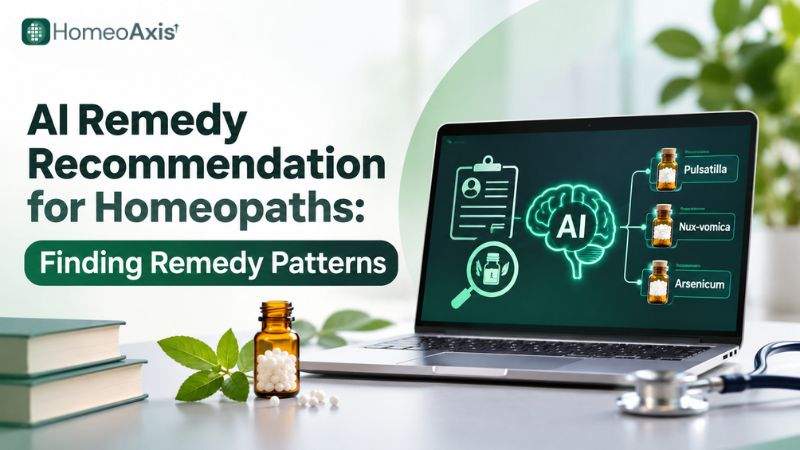
AI remedy recommendation software helps homeopaths organise case information, identify symptom patterns and generate a shortlist of possible remedies. It can support repertorisation and case review, but it should not replace a qualified practitioner's clinical judgement. In a 2026 study of 100 acute cases, four general-purpose AI chatbots included the practitioner's initial remedy in an average of 36.5% of recommendations and ranked it first in 20.8% of cases.
These figures measure agreement with practitioners' initial choices, not treatment effectiveness or clinical accuracy. AI-generated suggestions should therefore be reviewed against the complete case, relevant medical information and the practitioner's own assessment.
Key Takeaways For AI Remedy Recommendation
AI remedy recommendation tools analyse symptoms, modalities, generals and other case details to identify possible remedy patterns.
A remedy shortlist is a decision-support aid, not a prescription or a confirmed diagnosis.
Research comparing AI suggestions with homeopathic practitioners has found variable agreement.
General-purpose chatbots and purpose-built homeopathic remedy finders are different types of tools and should not be treated as interchangeable.
Homeopaths should verify suggested remedies against the complete case and relevant materia medica and repertory references.
Patient privacy, data handling, transparency and practitioner control are important when choosing AI-assisted software.
What Is AI Remedy Recommendation in Homeopathy?
AI remedy recommendation is the use of artificial intelligence to organise homeopathic case information and suggest remedies that may correspond to the recorded symptoms and characteristics.
A homeopath may enter details such as:
Chief complaints and associated symptoms
Modalities, including what makes a symptom better or worse
Physical generals, such as thirst, temperature preference and sleep
Mental and emotional characteristics
Relevant medical and family history
Previous prescriptions and patient responses, where available
The AI system processes the available information and identifies patterns that may help the practitioner review possible remedies.
For example, a case may contain information about a headache, its location, the time it occurs, associated symptoms and factors that aggravate or relieve it. An AI-assisted tool can organise these details and present possible remedy matches for further evaluation.
The purpose is to support case analysis, not to make the final prescription. The practitioner must review the original case, assess the importance of each symptom and decide whether a suggested remedy is appropriate.
How Is AI Remedy Recommendation Different from a Chatbot?
A general-purpose AI chatbot responds to prompts using a broad language model. A purpose-built homeopathic remedy finder or AI case-analysis system is designed around a more specific workflow, such as symptom selection, repertory references, remedy matching or historical case analysis.
These tools may produce different outputs because they use different data, methods and instructions. A chatbot's answer should not automatically be treated as equivalent to a structured repertorisation result.
How Does AI Identify Remedy Patterns?
AI systems identify remedy patterns by processing the case details supplied to them and comparing relevant features to the information available within their system.
The exact method depends on the software. A general workflow may include the following steps.
Step 1: Collecting Case Information
The practitioner records the patient's complaints, symptoms, modalities, generals and other relevant details.
The quality of the output depends partly on the quality and completeness of the input. Missing or unclear information can affect the suggestions produced by an AI system.
Step 2: Structuring the Symptoms
The software organises the information into identifiable fields or symptom categories.
For example, a free-text description may contain several details about a complaint. A structured system can separate the location, sensation, timing and modalities to make the information easier to review.
Step 3: Identifying Relevant Patterns
The AI system analyses the available case information and looks for relationships between symptoms and remedy characteristics.
Depending on the tool, this may involve repertory information, remedy profiles, constitutional characteristics or patterns from historical cases.
Step 4: Generating Possible Remedy Matches
The system produces a list or ranking of possible remedies. Some tools may also provide confidence scores or explanations for their suggestions.
A confidence score should be understood as a system-generated indicator. It is not proof that a remedy will work or that the recommendation is clinically correct.
Step 5: Practitioner Review
The homeopath reviews the suggested remedies against the original case and relevant materia medica and repertory references.
The practitioner should also consider whether the patient's symptoms require medical examination, investigation or treatment outside the scope of homeopathic case analysis.
AI-Assisted Remedy Analysis Workflow
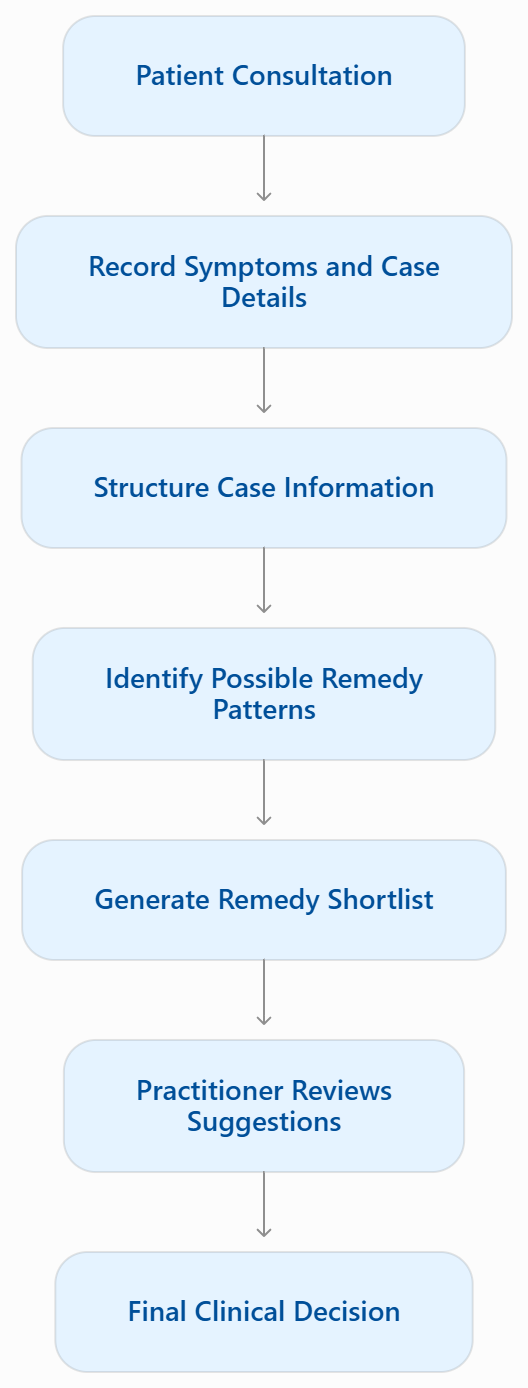
This workflow illustrates a support process. It does not mean that every AI tool uses the same technical method or that the generated shortlist is clinically validated.
What Does Research Say About AI Remedy Recommendations?
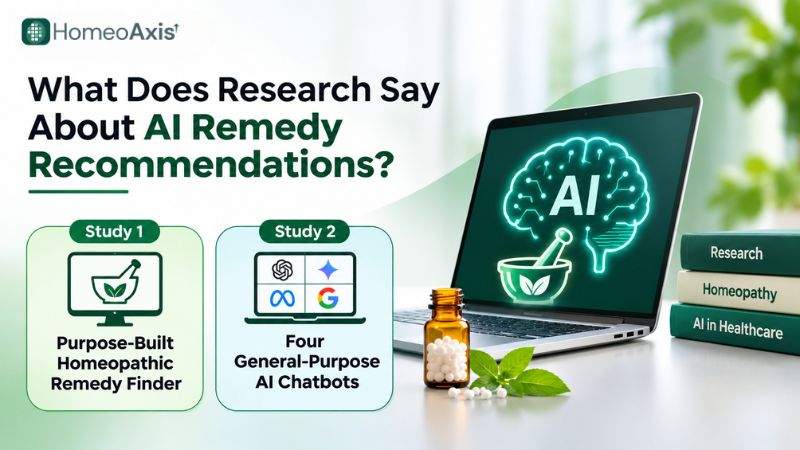
Research comparing AI-generated remedy suggestions with homeopathic practitioners' choices has found that the recommendations do not always match. The results also vary between purpose-built remedy finders and general-purpose chatbots.
Two studies involving 100 acute cases provide useful context.
Study 1: Purpose-Built Homeopathic Remedy Finder
A 2025 study, The Application of Artificial Intelligence in Acute Prescribing in Homeopathy: A Comparative Retrospective Study, compared a commercially available homeopathic remedy finder with practitioner recommendations from 100 acute cases.
The study reported:
Comparison | Result |
Practitioner's remedy appeared somewhere in the tool's results | 59% |
Practitioner's remedy appeared in the top three | 37% |
Practitioner's remedy was the top match | 17% |
The remedy finder returned between one and 20 prioritised suggestions for each complaint. The practitioner still had to decide which remedy, if any, was appropriate.
The study also had limitations. The 100 cases covered 22 of the 74 complaint categories available in the remedy finder. The findings therefore represent a particular set of acute cases, not every type of homeopathic consultation.
What this means: A purpose-built remedy finder may help practitioners explore possible matches, but its results did not consistently reproduce the practitioner's initial choice.
Source: The Application of Artificial Intelligence in Acute Prescribing in Homeopathy.
Study 2: Four General-Purpose AI Chatbots
A 2026 study published in Healthcare, titled Comparing AI Chatbots to Live Practitioners of Homeopathy: A Comparative Retrospective Study, evaluated four free, publicly accessible AI chatbots using practitioner notes from the same 100 acute cases.
The researchers compared the chatbot suggestions with the practitioners' initial remedy recommendations.
The study reported:
Finding | Result |
Practitioner's initial remedy included somewhere in chatbot recommendations, on average | 36.5% |
Practitioner's initial remedy ranked first, on average | 20.8% |
All four chatbots agreed with the practitioner's initial remedy | 6% |
All four chatbots agreed on a different remedy | 10% |
The study identified the four chatbot systems as:
Chatbot A: ChatGPT
Chatbot B: Grok
Chatbot C: Claude
Chatbot D: DeepSeek
The individual results varied:
Chatbot | Practitioner's remedy included | Practitioner's remedy ranked first |
ChatGPT | 33% | 20% |
Grok | 39% | 24% |
Claude | 27% | 21% |
DeepSeek | 47% | 18% |
The researchers tested the free chatbot versions between 21 May and 13 August 2025. These figures describe the versions and testing conditions used during that period. They should not be interpreted as measurements of current chatbot performance.
The study also reported differences when some cases were entered more than once. In one study, repeated queries sometimes produced different suggestions. The repeated-query observations were not designed as a controlled experiment on consistency, so they should be interpreted cautiously.
The researchers also found that the chatbots sometimes provided medical disclaimers and advised users to seek medical care.
What this means: General-purpose chatbots may generate remedy suggestions, but their recommendations were not routinely consistent with practitioners' initial choices or with one another.
Source: Comparing AI Chatbots to Live Practitioners of Homeopathy.
What Do the Two Studies Tell Us Together?
The two studies should not be treated as independent replications of the same experiment. They used different types of tools, and the chatbot study also compared results with the purpose-built remedy finder.
The purpose-built finder included the practitioner's remedy somewhere in its results in 59% of cases, while the four general-purpose chatbots had an average overlap of 36.5%. However, the top-match figures were closer: 17% for the purpose-built finder and 20.8% on average for the chatbots.
These numbers measure agreement with the practitioner's initial remedy selection. They do not establish that the practitioner's choice or the AI suggestion was clinically effective.
The studies also involved acute cases from a particular teaching-clinic setting. Their results should not automatically be generalised to chronic cases, other clinical settings or all AI products.
What About Other Research and Commentary?
A 2026 Letter to the Editor, Artificial Intelligence as an Assistant in Homeopathy, discussed the possibility that AI-generated repertorisation results may differ from established repertory approaches, including Radar repertories.
This is commentary, not a controlled clinical study. It is useful as a discussion of possible differences between AI tools and traditional repertory methods, but it does not establish the accuracy of any particular system.
Source: Artificial Intelligence as an Assistant in Homeopathy.
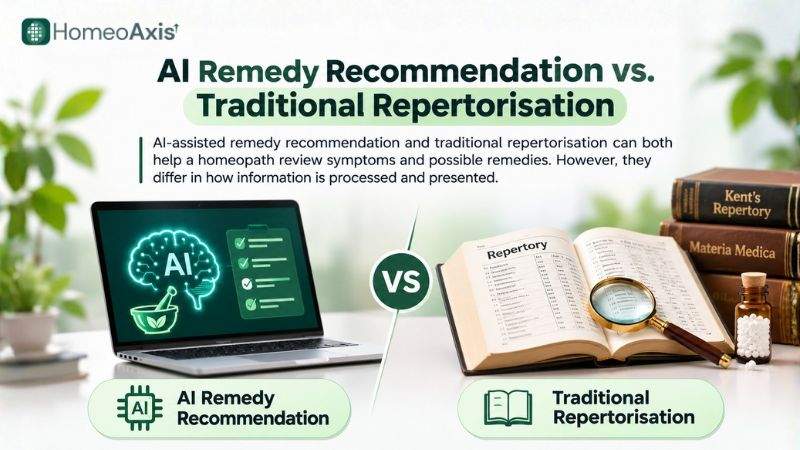
AI Remedy Recommendation vs. Traditional Repertorisation
AI-assisted remedy recommendation and traditional repertorisation can both help a homeopath review symptoms and possible remedies. However, they differ in how information is processed and presented.
Area | Traditional repertorisation | AI-assisted remedy recommendation |
Input | Symptoms selected and evaluated by the practitioner | Structured or free-text case information, depending on the tool |
Analysis | Practitioner selects rubrics and evaluates remedy coverage | Software processes case information and generates possible matches |
Remedy selection | Practitioner interprets repertory results and materia medica | AI produces a shortlist or ranking for practitioner review |
Flexibility | Depends on practitioner knowledge and repertory method | Depends on the system's data, model and configuration |
Explanation | Practitioner can inspect selected rubrics and repertory grades | Explanation varies by software |
Final decision | Practitioner | Practitioner |
Traditional repertorisation remains important because it allows the practitioner to select and assess rubrics directly. AI can provide another way to organise information, but it should not remove the need to understand the repertory or verify remedy characteristics.
Can AI Replace a Repertory?
No. AI-generated suggestions and repertory-based analysis are not necessarily the same process.
A repertory organises symptoms and their relationships with remedies. An AI tool may use repertory information, historical cases or other data to generate suggestions. The practitioner should be able to understand what information informed the result and verify it against reliable references.
For example, the OOREP publicum repertory uses a Kent-style grading approach, with grades from 1 to 3. A practitioner using a repertory-based workflow can review the selected rubrics and remedy grades rather than relying only on an unexplained AI ranking.
When Can Homeopaths Use AI Remedy Recommendation?
AI remedy recommendation can be useful as a supporting tool in several parts of a homeopathic workflow.
Reviewing Complex Case Notes
Long consultation notes may contain many symptoms, modalities and general characteristics. AI-assisted structuring can help organise this information so the practitioner can review it more efficiently.
Identifying Possible Remedy Patterns
An AI tool can present possible remedy matches based on the information entered. This may help a practitioner explore options they want to investigate further.
Reviewing Historical Cases
Some systems can compare a new case with previously recorded cases. This can help practitioners find similar case records, provided the underlying data is relevant and appropriately managed.
Supporting Follow-Up Reviews
Structured case information can make it easier to compare a patient's recorded symptoms over multiple consultations. The practitioner must still interpret changes and decide what they mean.
Supporting Clinic Documentation
AI case-analysis tools may help convert unstructured consultation notes into organised summaries. The practitioner should check the summary for missing, incorrect or misleading information before saving or using it.
Important: AI assistance should not delay urgent medical assessment. Symptoms that may indicate a serious or time-sensitive condition require appropriate medical care.
How HomeoAxis Uses AI for Homeopathic Case Analysis
HomeoAxis is a homeopathy clinic management platform that includes AI-assisted features alongside patient records, appointments, prescriptions, billing and clinic workflows.
Its AI-related features are described on the HomeoAxis homepage and the AI Case Analysis page.
AI Remedy Recommendation
The HomeoAxis homepage describes an AI Remedy Recommendation feature that analyses constitution, modalities and generals to suggest possible remedies with confidence scores and a cure-time prediction.
These outputs should be treated as decision-support information. A confidence score or estimated timeline does not establish that a remedy is clinically appropriate or that a particular treatment outcome will occur.
AI Case Analysis
The AI Case Analysis feature is described as a tool that structures case information, suggests remedies and helps practitioners review similar cases from their clinic's history.
The homepage also describes extraction of 21 structured fields from free-text consultation notes and the creation of a consultation summary.
The published product information describes these capabilities, but it should not be taken as evidence that the AI has been clinically validated to diagnose conditions or select effective treatments.
Formula Discovery AI
HomeoAxis also describes Formula Discovery AI, which identifies recurring remedy combinations in a clinic's case history. Practitioners can use this feature to review patterns in their records and organise formulas for further examination.
A recurring pattern in historical records does not, by itself, prove that a formula is effective. The quality of the underlying records and the method used to assess outcomes remain important.
Clinic-Mode AI
The HomeoAxis homepage describes Clinic-Mode AI as an option that restricts AI learning to a clinic's own cases. The AI Case Analysis page also describes privacy controls for clinic data and the ability for clinics to choose whether to contribute to or read from a shared pool.
Practitioners should review the product's current settings and privacy information to understand which data-sharing choices apply to their account.
Patient Records and Homeopathy-Specific Fields
HomeoAxis includes structured case-history fields such as chief complaint, generals, thermal state, thirst, sleep, bowel, mind, modalities and family history. These fields can help practitioners maintain organised records and support consistent documentation.
For more information, visit HomeoAxis Features and AI Case Analysis.
Limitations, Patient Privacy and Responsible Use
AI remedy recommendation has limitations. The output depends on the information entered, the system's underlying data and the method used to generate suggestions.
Homeopaths should consider the following points before relying on an AI-assisted tool.
AI Suggestions May Be Incomplete
An AI system may overlook an important symptom, misunderstand a description or give too much importance to a less relevant detail. Practitioners should review the original case rather than relying only on an AI-generated summary.
Recommendations May Differ Between Tools
Different AI systems can produce different suggestions from the same case. A result from one chatbot or software product should not be assumed to represent a standard or universally accepted remedy recommendation.
Historical Data Does Not Prove Effectiveness
A system that identifies similar historical cases or recurring remedy patterns is analysing recorded information. Similarity or repetition does not establish causation or prove that a remedy produced a particular outcome.
Patient Data Requires Careful Handling
Homeopathic case records may contain personal and health-related information. Before using AI features, clinics should understand:
What patient information is collected and processed.
Whether identifying details are removed before AI processing.
Which internal and third-party services receive information.
Whether data may be processed outside India.
What controls are available for shared or clinic-specific data.
How long patient records and AI-related data are retained.
How patients can exercise applicable data-protection rights.
HomeoAxis's published Privacy Policy states that patient names, identifying numbers and free-text narrative fields are stripped before data is transmitted to its internal AI processing service. It identifies Gemini, Anthropic and Groq as underlying LLM providers, depending on configuration, and says they receive anonymised prompts. The policy also states that the primary servers are in India and that some third-party services may process data in other countries.
The HomeoAxis AI Case Analysis page separately describes clinic controls for contributing to or reading from a shared pool. Clinics should review the current product settings and applicable privacy documentation to understand these arrangements before enabling data-sharing features.
Understand the DPDP Act and Rules
India's Digital Personal Data Protection Act, 2023 and the Digital Personal Data Protection Rules, 2025 establish a framework for processing digital personal data.
The Act uses the terms Data Fiduciary and Data Processor. A clinic and its software provider should understand their respective responsibilities based on the actual data-processing arrangement.
The Rules have a phased commencement schedule:
Rules 1, 2 and 17–21 came into force on publication.
Rule 4 is scheduled to come into force one year after publication. The Gazette is dated 13 November 2025, making 13 November 2026 the corresponding calendar date. Some summaries refer to 14 November 2026 because of the Gazette's publication and issue-date presentation. Rule 4 concerns registration and obligations of Consent Managers; it is not a general compliance deadline for every clinic.
Rules 3, 5–16, 22 and 23 are scheduled to come into force 18 months after publication, corresponding to 13 May 2027.
Clinics should check the official notifications and obtain appropriate legal advice for their specific responsibilities rather than treating these dates as a substitute for a compliance assessment.
Sources: Digital Personal Data Protection Act, 2023 and Digital Personal Data Protection Rules, 2025 – Gazette notification.
How to Choose AI Remedy Recommendation Software
Homeopaths should evaluate AI software based on its usefulness, transparency, data practices and ability to fit into their existing consultation workflow.
Consider these questions before choosing a platform:
Does it support homeopathic case information? Check whether the software can handle symptoms, modalities, generals and other relevant case details.
Can you review the reasoning? Prefer tools that make their suggestions and supporting information understandable.
Can you verify the output? Check whether the recommendations can be reviewed against repertory and materia medica references.
Does it preserve practitioner control? The software should support the practitioner rather than automatically make clinical decisions.
Does it manage patient records securely? Review access controls, data handling, retention and privacy documentation.
Does it fit your clinic workflow? Consider whether case analysis works alongside appointments, patient records, prescriptions and follow-ups.
Are its claims supported by evidence? Distinguish product features from independently demonstrated clinical performance.
A useful AI tool should make case information easier to review without making the practitioner dependent on an unexplained recommendation.
Frequently Asked Questions
What is AI remedy recommendation in homeopathy?
AI remedy recommendation uses software to analyse recorded symptoms, modalities, generals and other case information to suggest possible remedies. It supports case review but does not replace the homeopath's assessment or final decision.
Can ChatGPT recommend homeopathic remedies?
ChatGPT can generate homeopathic remedy suggestions when prompted, but its output may vary and should not be treated as a verified prescription. In a 2025 test of the free version, ChatGPT (Chatbot A) included the practitioner's initial remedy in 33% of cases and ranked it first in 20%. The study used 100 acute cases and testing took place between 21 May and 13 August 2025. These figures describe that study's testing conditions, not current ChatGPT performance or clinical efficacy.
Is AI remedy recommendation accurate?
There is no single accuracy figure that applies to all AI remedy recommendation tools. Studies have reported different levels of agreement between AI suggestions and practitioners' initial remedy choices. Agreement is not the same as clinical effectiveness, so practitioners should independently review the case and the suggested remedies.
Can AI replace traditional repertorisation?
No. AI can help organise case information and suggest possible remedy matches, but traditional repertorisation allows practitioners to select and assess rubrics directly. AI-generated results should be checked against repertory and materia medica references.
What is the difference between a homeopathic remedy finder and an AI chatbot?
A purpose-built remedy finder is designed for a specific homeopathic workflow, such as symptom selection and remedy matching. A general-purpose AI chatbot responds to a wide range of prompts using a general language model. Their methods and outputs may differ.
Is AI useful for analysing chronic homeopathic cases?
AI tools may help structure chronic case records, organise symptoms and review historical information. However, the studies discussed in this article focus on acute cases. Their findings should not be used as evidence of performance in chronic case analysis.
What should homeopaths check before using AI with patient records?
Practitioners should understand what data the software collects, how it is processed, whether identifying information is removed, which third-party services receive data, what sharing controls exist and how records are retained. They should also review the applicable privacy policy and their responsibilities under Indian data-protection law.
Final Thoughts
AI remedy recommendation can help homeopaths organise case information, explore possible remedy patterns and review historical records. Its usefulness depends on the quality of the information entered, the transparency of the software and the practitioner's ability to assess the output.
Research comparing AI suggestions with practitioners' initial remedy choices has found variable agreement. In one study, repeated queries sometimes produced different suggestions. These findings highlight why AI recommendations should be reviewed rather than accepted automatically.
The practical approach is to use AI as a supporting tool while keeping case interpretation and clinical decisions with the qualified practitioner. Patient safety, appropriate medical assessment and responsible handling of patient information should remain priorities.