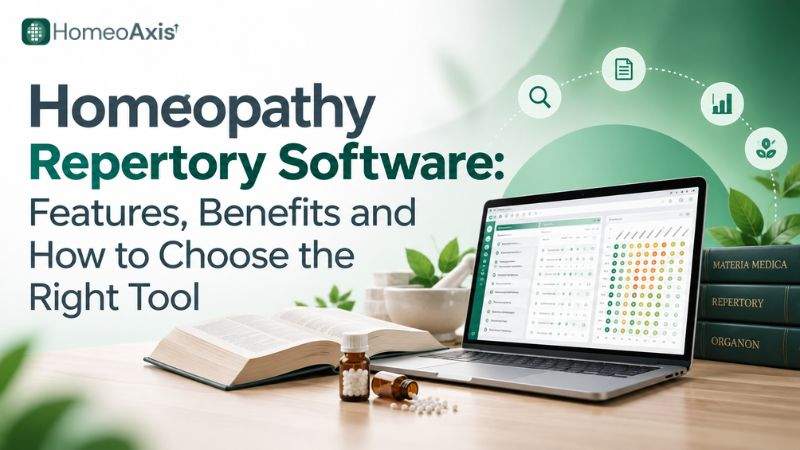
Homeopathy repertory software helps practitioners search symptom rubrics, compare remedies, review remedy grades, and organise repertorisation digitally. The right tool depends on the repertories you need, materia medica references, device and offline support, pricing, and whether you also need patient records and clinic management. For broad repertory libraries, compare Hompath Zomeo and RadarOpus; for a free starting point, consider OOREP or Similia; for integrated clinic management, evaluate HomeoAxis.
Product disclosure: HomeoAxis is our product. It uses the OOREP publicum repertory rather than Synthesis or Complete Repertory. OOREP may be sufficient if you only need online repertory lookups; HomeoAxis is intended for practitioners who also want clinic-management features.
What Is Homeopathy Repertory Software?
Homeopathy repertory software is a digital tool for searching repertory rubrics, comparing associated remedies, reviewing remedy grades, and organising repertorisation. It can supplement or replace manual searches through printed repertories.
A repertory organises symptoms into rubrics and lists remedies associated with them. Digital repertory software makes these rubrics searchable and can help practitioners compare remedies across selected symptoms.
Depending on the product, features may include searchable repertories, remedy grading, cross-references, materia medica books, saved cases, and repertorisation sheets. Integrated platforms may also include patient records, appointments, and prescriptions.
Not every product includes all these functions. Some tools focus on repertorisation, while others combine repertory searches with case management or clinic administration.
What Features Should You Look For?
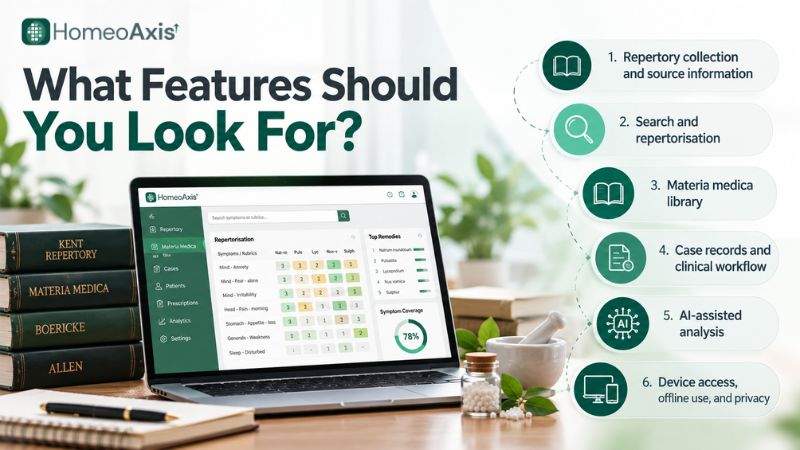
The most important features are searchable repertories, transparent remedy grading, useful materia medica references, and a workflow that supports case analysis.
1. Repertory collection and source information
Check the names and number of repertories included. Depending on the product and licence, collections may include Kent, Synthesis, Complete Repertory, Murphy's Repertory, or Boger-Boenninghausen Characteristics and Repertory (BBCR).
Some tools provide a single repertory, while others offer larger collections or sell additional repertories separately. The source matters as much as the library size, particularly if you rely on a specific repertory in your work.
2. Search and repertorisation
Good homeopathic repertorization software should support symptom and rubric searches, remedy comparisons, and clear presentation of grades.
Useful functions include partial-word search, cross-references, filters, and the ability to review the rubrics behind a result. These features help users understand how a comparison was produced rather than relying on a result without checking its source.
3. Materia medica library
Check which materia medica books and remedy profiles are included. Library size alone is not enough: the references you use should be available and searchable.
Some products bundle reference books with their repertories, while others offer separate libraries or additional collections. Include any required add-ons when comparing prices.
4. Case records and clinical workflow
Homeopathy case analysis software may include symptom notes, case histories, saved repertorisation sheets, and follow-up records. Integrated systems connect these records with appointments and prescriptions, reducing the need to transfer information between applications.
For a multi-doctor or multi-branch clinic, patient access settings, user permissions, and record organisation also matter. These features affect how conveniently a team can manage practice information.
5. AI-assisted analysis
Some products use AI to analyse case information or suggest relevant rubrics. Treat these outputs as suggestions to review against the original repertory and other references, not as independently validated clinical conclusions.
Before using AI features, understand what information is processed, which providers receive it, and whether usage is subject to limits or additional charges. AI suggestions should remain reviewable and correctable by the user.
6. Device access, offline use, and privacy
Check whether the software runs on Windows, macOS, mobile devices, or a browser. Offline support is a separate feature: a web application is not automatically available without an internet connection.
For patient records, review access permissions, backup and export options, retention practices, and the provider's privacy documentation. Indian clinics should also assess their applicable obligations under the Digital Personal Data Protection Act, 2023, and related rules.
What Are the Benefits of Digital Repertory Software?
Digital repertory software can make rubric searches more convenient, help organise comparisons, and reduce the need to search multiple printed volumes manually. Its practical value depends on the source material and how well the tool fits the user's workflow.
A practical example: comparing four rubrics
Suppose a practitioner is reviewing a fictional case and selects four rubrics. A digital tool can display the selected rubrics and their associated remedy grades in one comparison grid.
Fictional rubric | Remedy A | Remedy B | Remedy C |
Rubric A | 3 | 2 | 1 |
Rubric B | 2 | 3 | 1 |
Rubric C | 1 | 2 | 3 |
Rubric D | 2 | 1 | 3 |
Illustrative total | 8 | 8 | 8 |
Illustrative example only. Rubrics, remedies, grades, and totals are fictional and do not represent a real case or clinical recommendation.
The example shows how software can put selected rubrics and remedy grades into a single view. A displayed total does not establish that a remedy is clinically effective or that a particular score represents the correct treatment. Users still need to review the source entries and apply appropriate professional judgement.
Other practical benefits include faster rubric searches, easier remedy comparison, organised case information, fewer application switches, and access across supported devices. These are workflow benefits, not evidence that homeopathy is effective for a particular condition.
How Does Digital Repertorisation Work?
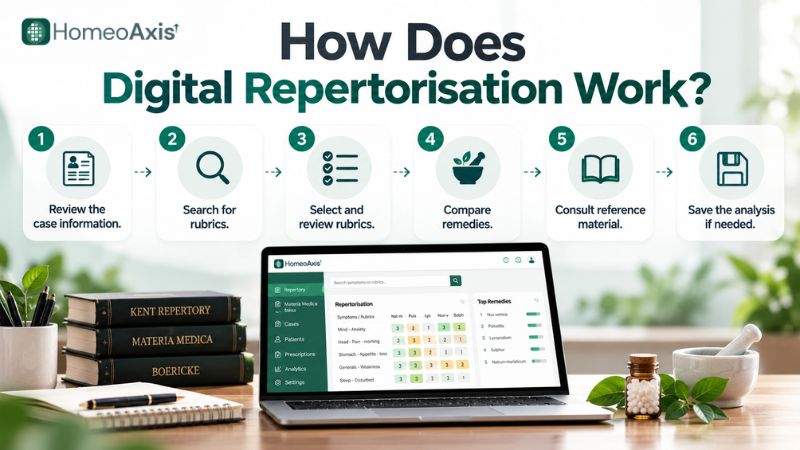
A typical digital repertorisation workflow involves reviewing case information, selecting relevant rubrics, comparing associated remedies, and checking the results against reference material.
Review the case information. Record and assess the information relevant to the case.
Search for rubrics. Use the software's search functions to locate relevant repertory entries.
Select and review rubrics. Check that the selected rubrics accurately represent the information being assessed.
Compare remedies. Review the remedies associated with the selected rubrics and their displayed grades.
Consult reference material. Review the original repertory entries and relevant materia medica sources.
Save the analysis if needed. Store the repertorisation sheet and related case notes if the software supports it.
The workflow varies by product. Automated suggestions should be checked rather than accepted without review. A repertorisation result organises information; it is not an independently validated diagnosis or proof of treatment effectiveness.
Homeopathy Repertory Software Comparison
The products below serve different needs. Hompath Zomeo and RadarOpus offer broad repertory and reference collections, Complete Dynamics centres on Complete Repertory, Similia offers free and paid options, OOREP provides a free online repertory resource, and HomeoAxis combines OOREP-based repertory access with clinic-management features.
Repertories and pricing
Software | Repertories and reference resources | Published pricing |
Advertises 40+ repertories, around 1,300 reference volumes, and information on 3,200+ remedies. | Zomeo is sold by quote; the provider does not publish a fixed price on its main product page. | |
Based on Synthesis, with graphical analysis, case management, and reference-library functions. | Pricing depends on package and licence term. The provider's comparison page lists rental options from €6 to €45 per month, excluding tax; lifetime pricing is available after registration. | |
Built around Complete Repertory, with additional features varying by edition. | Practitioner edition: €19 for one month or €15.83 per month on a one-year term, paid upfront at €190 for the year. | |
Free tier includes seven classical repertories and 21 materia medica books. Paid editions add premium repertories and features. | The listed Pro options for premium repertories cost €22.48–€24.99 per month. A separate Pro option without premium repertories is listed at €16.99 per month. | |
Publicly accessible repertory resource; publicum is derived from Kent and published under GPL v3. | Free to use online. | |
Uses OOREP publicum with Kent-style grades 1–3. It does not use Synthesis or Complete Repertory as its repertory source. | Paid clinic platform with a 14-day trial. Current plans are detailed below. |
Platform, offline access, and student options
Software | Platform and offline access | Student options |
Hompath Zomeo | Windows and macOS desktop versions. Firefly is available for iPhone, iPad, and Android. | Zomeo Academic offers 11 repertories and 150 reference volumes, plus 3,000+ remedies and student learning resources. |
RadarOpus | Windows and macOS. As of version 4.2, first activation requires an internet connection. Licence checks occur every 30 days for a dongleless licence or every 12 months for a dongle licence. | No student pricing published on the provider's main pricing information. |
Complete Dynamics | Windows, macOS, Linux, Android, and iOS, with edition availability varying by device. The provider states that internet access is not required for normal software use. | No separate student price published on the pricing pages reviewed. |
Similia | App-based. The provider marks offline mode as beta for certain paid options; offline availability is limited and should not be assumed for all features. | Special pricing for students and educators is advertised by the provider. |
OOREP | Browser-based online repertory. | A free resource for students who need online repertory lookups. |
HomeoAxis | Browser/PWA access. Supports an encrypted, read-only offline copy of clinic records on signed-in devices; new records need a connection to sync. Not every feature works offline. | No separate student plan published on the pricing page. |
How we evaluated these tools
This is a desk-based comparison of publicly available vendor pages, pricing information, feature descriptions, and licence details reviewed on 27 October 2026. It is not a hands-on clinical accuracy test, independent security audit, or endorsement of homeopathy's effectiveness. Prices, features, student terms, and licence conditions can change.
Which software should you shortlist?
For broad repertory libraries: Compare Hompath Zomeo and RadarOpus.
For Complete Repertory: Consider Complete Dynamics.
For a free starting point: Explore OOREP for online lookups or Similia's free tier.
For students: Compare Hompath Zomeo Academic and Similia's student or educator terms.
For integrated clinic management: Evaluate HomeoAxis if you also need patient records, appointments, prescriptions, and related practice workflows.
Is OOREP Enough for Basic Repertory Lookups?
OOREP may be enough if you only need to look up repertory entries online. Its public website describes a browser-based repertory resource that is free to use. It is not a complete clinic-management platform for patient administration, appointment scheduling, or prescription workflows.
Read the OOREP FAQ for repertory details and licensing information. The FAQ identifies publicum as repertory version 0.5 of OpenRep, derived from Kent and published under the GNU General Public License version 3 (GPL v3).
HomeoAxis uses OOREP publicum as its repertory source. The repertory is not exclusive to HomeoAxis, and users do not need to purchase HomeoAxis simply to look up publicly available OOREP entries. The GPL v3 licence governs reuse and distribution of the covered software; the applicable obligations depend on how it is used or distributed.
HomeoAxis: Repertory and Clinic Management
HomeoAxis combines OOREP-based repertory access with clinic-management functions. It is designed for homeopathic practitioners who want to manage practice activities alongside their repertory workflow.
Its published features include:
Repertory access: Search the OOREP publicum repertory and review its Kent-style grades.
Patient records: Maintain patient profiles, consultation notes, and case information.
Prescriptions: Create and manage digital prescription records.
Appointment scheduling: Organise appointments alongside patient records.
Clinic operations: Manage inventory, billing, follow-up reminders, and patient communication through supported modules.
Multi-clinic plans: Plus and Elite support multiple clinics, with plan-dependent limits.
AI-assisted case analysis: Use the platform's AI case-analysis features to support the review and organisation of case information. AI output requires practitioner review and should not be treated as a validated clinical conclusion.
Important limitations to understand
HomeoAxis does not include Synthesis or Complete Repertory as its repertory source. If you depend on either repertory, a product built around your required source may be a better fit.
Offline functionality is limited. HomeoAxis supports an encrypted, read-only offline copy of clinic records on signed-in devices. New records require a connection to sync, and not every platform feature works offline.
The HomeoAxis privacy policy describes India-based servers and third-party processing for some functions. It names Gemini, Anthropic, and Groq among the AI providers used depending on configuration. The policy also describes removing patient names, identifying numbers, and free-text narrative before structured case data is sent to AI providers. Read the current HomeoAxis privacy policy for the applicable details and limitations.
You can review HomeoAxis features and the HomeoAxis pricing page before choosing a plan.
How Much Does Homeopathy Repertory Software Cost?
Costs depend on the repertories included, subscription duration, number of users, and whether the product includes case management or clinic administration. Some vendors publish prices, while others require a quotation.
HomeoAxis pricing in India
The HomeoAxis pricing page lists the following monthly equivalents for plans billed annually. These prices were reviewed on 27 October 2026.
Plan | Regular price per month equivalent | Early-bird price per month equivalent | Clinic, doctor, and staff limits |
Lite | ₹2,399 | ₹1,599 | 1 clinic, 2 doctors, 3 staff |
Pro | ₹4,799 | ₹2,399 | 1 clinic, 2 doctors, 5 staff |
Plus | ₹5,599 | ₹3,999 | 3 clinics, 6 doctors, 15 staff |
Elite | ₹8,399 | ₹5,999 | 5 clinics, 12 doctors, 30 staff |
These are monthly equivalents, not month-to-month payment prices. Plans are billed annually, so the amount due is based on the selected annual plan. The pricing page labels the discounted amounts as early-bird prices but does not publish an end date for the offer. Confirm the final payable amount and applicable taxes at checkout.
HomeoAxis offers a 14-day trial. During the trial, every module is open on Lite. After the trial, ongoing repertory access depends on the eligible paid plan. Lite focuses on clinic profile, directory presence, and booking enquiries, while Pro, Plus, and Elite include the full platform from the start.
Competitor prices and approximate INR equivalents
Complete Dynamics publishes a Practitioner edition price of €19 for one month or €15.83 per month on a one-year term, paid as €190 upfront for the year.
Similia's pricing page lists Pro options at €22.48 per month for Saine Repertory and €24.99 per month for Complete Repertory 2026 and certain other premium repertory editions.
The approximate INR equivalents below use the European Central Bank reference rate of €1 = ₹106.4935 on 26 October 2026. The ECB rate for 27 October was not yet published when this article was updated.
Software or option | Published price | Approximate INR equivalent |
Complete Dynamics Practitioner, 1 month | €19 | ₹2,023 |
Complete Dynamics Practitioner, 1-year term | €15.83/month equivalent; €190 paid upfront | ₹1,686/month equivalent; approximately ₹20,234 upfront |
Similia Pro, Saine Repertory | €22.48/month | ₹2,394/month |
Similia Pro, Complete Repertory 2026 or certain other premium editions | €24.99/month | ₹2,661/month |
Source: ECB euro reference exchange rates, 26 October 2026. These conversions are approximate; taxes, bank conversion margins, and local reseller pricing can change the final amount.
Hompath sells Zomeo by quote and does not publish a fixed price on its main product page. RadarOpus pricing varies by package and licence term; its provider page lists rental options and provides further pricing information after registration.
When comparing costs, include repertory add-ons, updates, reference books, user seats, support, taxes, data exports, and any charges for AI usage or additional storage.
How to Choose the Right Software
Use the comparison tables to narrow the options, then test the shortlisted product against your actual repertory workflow. The key question is whether it includes the sources and features you need at a total cost you can justify.
Before paying, make sure you can find and review rubrics easily, access your preferred references, use the software on your devices, and understand how your data is stored or exported. If you manage a clinic, also assess whether the patient records, appointment, prescription, and follow-up features match your daily workflow.
What Does the Evidence Say About Homeopathy?
Choosing software is separate from determining whether homeopathy is clinically effective. Repertory software can organise rubrics, display remedy grades, and help users review reference material, but these functions do not establish that a remedy treats a medical condition.
The Australian National Health and Medical Research Council's 2015 information paper, Evidence on the effectiveness of homeopathy for treating health conditions, concluded that there were no health conditions for which there was reliable evidence that homeopathy was effective. This was the conclusion of that assessment; it should not be confused with later reviews of the process itself.
The US National Center for Complementary and Integrative Health also provides an overview of evidence and safety considerations in its homeopathy information page.
Software-generated rankings, automated rubric suggestions, and AI-assisted analyses should not be presented as proof of efficacy. Patients should receive appropriate evidence-based medical assessment and treatment and should not delay or replace necessary medical care with homeopathy.
Frequently Asked Questions
1. What is homeopathy repertory software?
Homeopathy repertory software is a digital tool for searching repertory rubrics, comparing associated remedies, reviewing remedy grades, and organising repertorisation. Some products also include materia medica libraries, case records, and clinic-management features.
2. Does HomeoAxis use Synthesis or Complete Repertory?
No. HomeoAxis uses the OOREP publicum repertory, based on Kent, with Kent-style grades 1–3. It does not use Synthesis or Complete Repertory as its repertory source. If either repertory is essential to your work, compare products that specifically include it.
3. Which software includes Complete Repertory?
Complete Dynamics is built around Complete Repertory. Hompath Zomeo also advertises Complete Repertory among its included resources. Similia offers a Pro option that includes Complete Repertory 2026. The included edition and licence terms vary by product.
4. Is homeopathy repertory software suitable for students?
Yes. Hompath Zomeo Academic offers 11 repertories and 150 reference volumes, and Similia advertises special student and educator pricing. OOREP is another free resource for online repertory lookups. Students should compare the included references, licence terms, and usage limits.
5. Is there free homeopathy repertory software?
OOREP provides a free online repertory lookup resource. Similia offers a free tier with seven classical repertories, 21 materia medica books, and limits of three new cases and three analyses per month according to its listed offering. These options differ in scope: OOREP is a repertory lookup tool, while Similia provides a broader app-based workflow with free-tier limits.
6. Can homeopathy repertory software work offline?
Some products offer offline access, but available functions vary. As of version 4.2, RadarOpus requires periodic licence checks. Similia describes its offline mode as beta for certain paid options. HomeoAxis supports a read-only offline copy of clinic records, with new records waiting for a connection to sync. Complete Dynamics states that internet access is not required for normal software use.
7. How much does homeopathy repertory software cost in India?
Costs range from free online resources to paid subscriptions and quoted packages. HomeoAxis lists early-bird monthly equivalents from ₹1,599 to ₹5,999 on annual-billed plans. Complete Dynamics Practitioner costs €19 for one month or €15.83 per month on a one-year term, approximately ₹2,023 or ₹1,686 per month using the ECB rate of 26 October 2026. Similia's premium repertory options cost €22.48–€24.99 per month, approximately ₹2,394–₹2,661 at the same rate. Taxes and payment-provider rates may differ.
8. Does AI-assisted repertorisation select the correct remedy?
AI-assisted tools may suggest rubrics or help organise case information, but their outputs need review against the original repertory and other references. AI suggestions are not independently validated clinical conclusions and do not prove that a remedy is effective.
Conclusion
Choose homeopathy repertory software based on the repertories you need, the quality of its search and reference features, device support, licence terms, privacy, and total cost. Hompath Zomeo and RadarOpus are options for broad libraries; Complete Dynamics is built around Complete Repertory; OOREP and Similia offer free starting points; and HomeoAxis combines OOREP-based repertory access with clinic-management features.
Compare the actual features and licensing terms rather than relying on claims about library size or AI capabilities. Repertorisation software organises information; it does not establish the clinical effectiveness of homeopathy.
Author Bio
Prashant Singh, CTO and software expert
Prashant Singh is the CTO at HomeoAxis and works on software and digital workflows for homeopathy practices. HomeoAxis is our product.
Medical note: This article compares software features and pricing for informational purposes. It is not medical advice and does not establish the effectiveness of homeopathy. Product details and prices may change; consult the linked vendor pages for current information before purchasing.