

Author: HomeoAxis Content Team
Expert Reviewer: Prashant Singh, CTO, HomeoAxis
Opening a second clinic can increase your reach and revenue, but growth should not come at the cost of patient care. To expand safely, first make your existing homeopathy clinic run reliably without depending on you for every routine decision. Document SOPs, delegate responsibilities, measure performance for 3–6 months, and only then commit to a new location.
A second clinic should be treated as a repeatable operating system, not simply another room, signboard, and appointment book. The goal is to reproduce the quality of your first clinic while adapting to the needs of a new location.
Note: This article provides operational guidance for clinic expansion. Registration, professional practice, employment, privacy, and other compliance requirements can vary by state and should be verified with the relevant authorities before opening a new clinic.
Key Takeaways
Stabilise the first clinic before committing to a second location.
Document consultation, prescription, follow-up, billing, inventory, and patient communication SOPs.
Delegate routine work while keeping clinical decisions under appropriate professional supervision.
Test whether the first clinic can operate reliably without the owner being physically present every day.
Choose the second location based on patient demand, accessibility, competition, and realistic operating costs.
Keep patient records, prescriptions, follow-ups, and medicine processes consistent across branches.
Use clear staff roles, permissions, reporting systems, and branch-level performance metrics.
Review the second clinic regularly and have an exit or correction plan if it underperforms.
Is Your First Clinic Ready for a Second Location?
The first clinic is ready when it can deliver consistent patient care and handle routine operations without depending on the owner for every decision.
Before signing a lease or hiring a new team, check whether your existing clinic can function effectively when you are not there every day.
Second-Clinic Readiness Test
Area
What to check
Patient care
Case-taking, prescriptions, follow-ups, and documentation follow the same standards.
Staff
Staff can handle routine administrative tasks without constant owner intervention.
Operations
Appointments, billing, patient communication, and inventory continue smoothly.
Financials
The first clinic has predictable revenue and sufficient operating margin.
Leadership
A responsible person can manage routine issues when you are away.
Systems
Records, reports, SOPs, and communication are documented rather than dependent on memory.
Owner dependency
Track the number of routine decisions, approvals, staff queries, or operational problems that still require you each week.
A useful test is to run the first clinic with greater delegation for 3–6 months. If patient experience, revenue, staff performance, and daily operations remain stable, you have stronger evidence that the model can be repeated.
The sequence should be:
Stabilise → Delegate → Measure → Commit → Replicate → Monitor
How Should You Plan the Expansion of a Homeopathy Clinic?
A second clinic expansion plan should cover demand, location, people, processes, finances, compliance, and patient continuity before the new branch opens.
Do not start with the question, “Where should I rent a clinic?” Start with, “What must be true for this clinic to work?”
Build the Expansion Plan
Area
What to decide
Demand
Is there enough patient demand in the target area?
Location
Is the clinic accessible to the intended patient group?
Clinical model
Will the owner consult there, or will an associate doctor lead it?
Staff
Who will handle reception, patient communication, billing, and medicines?
SOPs
Which processes must remain identical across both clinics?
Inventory
Which remedies, potencies, dispensing materials, and other supplies are required?
Technology
How will appointments, records, prescriptions, billing, and reports be managed?
Compliance
Which registrations, professional requirements, local permissions, and records apply?
Marketing
How will the new branch be discovered locally?
Contingency
What happens if patient volume or revenue is lower than expected?
The plan should also define a launch budget, break-even target, staffing timeline, and review dates before you commit to the location.
How Much Does It Cost to Open a Second Homeopathy Clinic?
A second homeopathy clinic can require several lakh rupees depending on location, clinic size, equipment, staffing, interiors, and operating model.
For planning purposes, an illustrative internal estimate of ₹4–10 lakh can be used for basic setup and launch costs. This is not a market-standard figure and should be replaced with actual local quotations before making a financial decision.
The estimate can cover items such as:
Basic interiors and furniture.
Signage and clinic setup.
Computer and operational equipment.
Initial medicine and consumable stock.
Registration and professional documentation costs where applicable.
Initial branding and local marketing.
Basic technology and software setup.
The ₹4–10 lakh estimate excludes rent deposits, salaries, and working capital unless specifically included in your own budget. These should be planned separately because they can materially change the amount of capital required.
Build a Separate Working-Capital Buffer
A clinic can look profitable on paper and still face cash-flow pressure during the first few months.
Budget separately for:
Rent and deposit.
Doctor and staff salaries.
Electricity, internet, and other recurring expenses.
Medicine replenishment.
Marketing.
Software and communication costs.
Unexpected repairs or operational expenses.
Working capital until patient volume becomes predictable.
Use real property, vendor, staffing, and equipment quotations before committing to a lease.
How Do You Choose the Right Location for a Second Clinic?
The right second-clinic location is one where your target patients can reach you conveniently and where expected demand justifies the recurring cost.
Do not choose a location only because rent is cheaper.
Evaluate:
Existing patient enquiries from nearby areas.
Population and household profile.
Accessibility and parking.
Visibility and signage opportunities.
Nearby residential areas.
Competition from other homeopathy and healthcare providers.
Local commercial rent.
Availability of qualified staff.
Potential for online and local search visibility.
Expected patient volume after the launch period.
A useful approach is to analyse where your current patients already come from. If a meaningful share of patients travels long distances to your existing clinic, that can reveal potential locations for a second branch.
Should You Hire Another Doctor or Manage Both Clinics Yourself?
The safest staffing model depends on patient volume, your availability, and whether the second clinic can operate without compromising clinical continuity.
Model
Best suited for
Main trade-off
Owner manages both
Early-stage expansion with manageable patient volume
Limited owner availability
Owner + associate doctor
Growing branch with defined clinical SOPs
Requires careful delegation
Full-time branch doctor
Higher-volume second clinic
Higher fixed cost and stronger hiring requirements
Part-time/visiting doctor
Testing demand before a full commitment
Limited availability
If an associate doctor is responsible for consultations, verify the applicable professional registration and regulatory requirements, including the practitioner's valid entry in the relevant professional register such as the National Commission for Homoeopathy framework where applicable.
The owner should not solve a staffing problem by simply increasing the number of patients each doctor sees. Quality, documentation, and follow-up capacity need to remain realistic.
How Do You Standardise Patient Care Across Two Clinics?
Patient care becomes easier to standardise when both clinics follow the same documented clinical and operational processes while allowing doctors to exercise appropriate professional judgement.
For a homeopathy clinic, SOPs can cover:
Patient registration.
Case-taking and history documentation.
Repertorisation or other clinical assessment processes used by the practitioner.
Remedy and potency documentation.
Prescription preparation.
Chronic-case follow-up.
Patient instructions.
Medicine dispensing.
Follow-up reminders.
Handling of reports and attachments.
Billing and payment.
Patient complaints and escalation.
The objective is not to make every consultation identical. It is to make the process around clinical care consistent.
For example, two doctors may reach different professional conclusions for a patient, but both should document the case, prescription, follow-up plan, and relevant patient communication according to the clinic's agreed standards.
How Do You Manage Patient Records and Privacy Across Multiple Clinics?
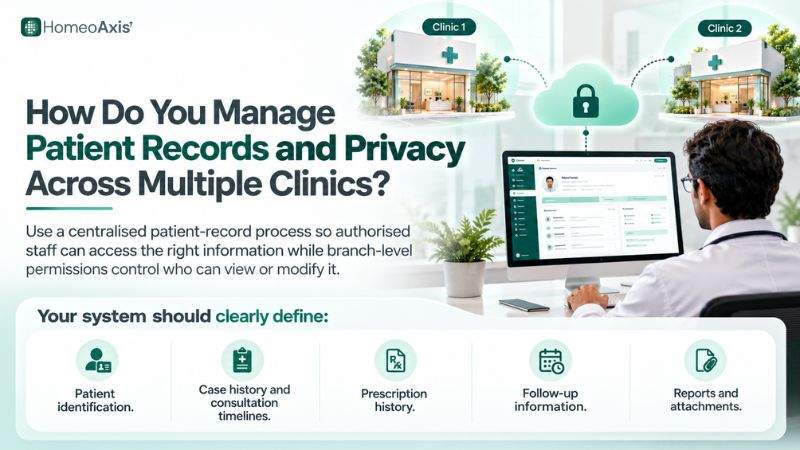
Use a centralised patient-record process so authorised staff can access the right information while branch-level permissions control who can view or modify it.
Patients should not have to restart their entire history simply because they visit another branch.
Your system should clearly define:
Patient identification.
Case history and consultation timelines.
Prescription history.
Follow-up information.
Reports and attachments.
Branch and doctor access.
Staff permissions.
Data correction procedures.
Patient record transfer when required.
Backup and export processes.
Data retention and deletion policies.
Privacy requirements should also be reviewed as part of the expansion plan. India's Digital Personal Data Protection framework establishes obligations around processing digital personal data, with the DPDP Rules, 2025 providing additional operational requirements through a phased commencement framework. Verify the rules applicable on the date of implementation rather than relying on an old checklist.
For regulatory reference, see the official Ministry of Electronics and Information Technology sources listed below.
How Should You Standardise Medicines and Inventory Across Branches?
Each branch should have a defined medicine inventory system covering stock levels, potency, batch information, expiry, dispensing, and replenishment.
Homeopathy clinics may need to manage different potencies, mother tinctures, dilutions, globules, drops, bottles, and other dispensing materials depending on their practice model.
Create a branch-level inventory SOP covering:
Approved medicines and suppliers.
Common potency ranges.
Minimum and maximum stock levels.
Batch and expiry tracking.
Stock transfer between branches.
Medicine dispensing.
Damaged or expired stock.
Reorder responsibility.
Inventory reconciliation.
The objective is to prevent a situation where one clinic has excess stock while another repeatedly runs out of commonly used medicines.
What Legal and Compliance Areas Should You Check Before Opening?
Before opening a second clinic, verify the registrations, professional requirements, local permissions, employment obligations, and data-protection requirements that apply to the new location.
At a minimum, check these categories:
Clinical establishment requirements: Determine whether the Clinical Establishments Act applies in the relevant state or whether state-specific rules govern the clinic.
Professional registration: Confirm that practising doctors meet applicable professional registration requirements.
Local permissions: Check municipal, premises, signage, fire, waste-management, or other local requirements where applicable.
Employment and commercial obligations: Review contracts, payroll, tax, and other business requirements.
Patient data: Establish appropriate privacy, access, retention, and security processes for digital patient information.
The Clinical Establishments Act has been adopted in multiple States/UTs, but health is a state subject and requirements can vary. Check the Ministry's current state-status information before relying on a national assumption.
How Do You Manage Two Clinics at the Same Time?
Managing two clinics requires a clear division between decisions that need the owner and routine decisions that should be handled by the branch team.
A practical operating structure can look like this:
Area
Owner/central role
Branch role
Clinical standards
Define standards
Follow standards and document care
Staff
Hiring and performance review
Daily supervision
Appointments
Monitor capacity
Manage daily schedule
Billing
Review reports
Handle routine billing
Inventory
Set controls
Monitor and replenish stock
Marketing
Set strategy
Manage local execution
Patient complaints
Escalation
First-level resolution
Finance
Review branch performance
Record daily transactions
The owner should spend more time reviewing systems and performance rather than solving every routine issue personally.
Measure Owner Dependency
A simple metric is:
Owner-dependency count = number of routine decisions, approvals, staff queries, or operational problems requiring the owner's direct involvement each week.
Track this number before and after delegation. If the number remains high, the clinic may not yet be operationally independent enough to scale further.
What Should You Look for in Multi-Clinic Management Software?
The right multi-clinic management software should keep branches connected while giving each clinic controlled access to the information and workflows it needs.
For a homeopathy practice, evaluate software based on:
Multiple clinic or branch support.
Role-based staff access.
Centralised patient records.
Appointment scheduling across clinics.
E-prescriptions.
Billing and payment tracking.
Medicine inventory.
Branch-level reports.
Follow-up reminders.
Patient communication.
Data export and backup.
Clear access controls.
If you are comparing homeopathy clinic software in India, do not select a platform only because it offers appointment booking. The more important question is whether it can support the operational model you are trying to reproduce across locations.
Where HomeoAxis Can Fit
HomeoAxis is designed specifically for homeopathy practices and includes multi-clinic and staff management. Its current product information states that clinics can be managed with role-based access, while its reporting tools provide clinic-level and organisation-level views.
For a growing practice, this can help keep appointments, patient records, prescriptions, billing, inventory, and branch performance within one operational system instead of maintaining separate tools for every location.
HomeoAxis also lists multi-clinic support, role-based access, e-prescriptions, billing, inventory, and analytics among its platform capabilities.
The software should support your operating process, not replace the need for SOPs or clinical oversight.
How Do You Know Whether the Second Clinic Is Performing Well?
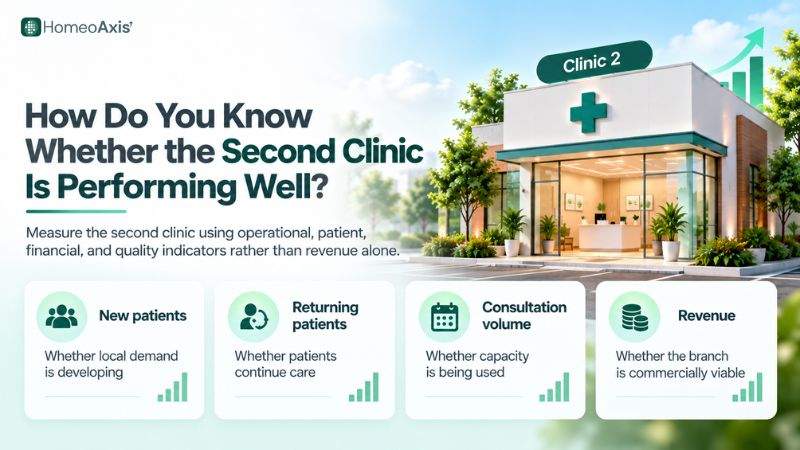
Measure the second clinic using operational, patient, financial, and quality indicators rather than revenue alone.
Track metrics such as:
Metric
What it tells you
New patients
Whether local demand is developing
Returning patients
Whether patients continue care
Consultation volume
Whether capacity is being used
Revenue
Whether the branch is commercially viable
Revenue per consultation
Financial efficiency
No-show rate
Appointment quality
Follow-up completion
Continuity of care
Patient feedback
Experience and service quality
Medicine stock-outs
Inventory efficiency
Owner-dependency count
Operational independence
Review these metrics monthly during the first year.
A branch that has increasing patient numbers but poor follow-up completion may need operational correction before expansion continues.
What Should a 12-Month Expansion Roadmap Look Like?
A 12-month roadmap gives you enough time to validate the first clinic, launch carefully, and measure whether the second branch is actually sustainable.
Phase
Timeline
Main focus
Phase 1
Months 1–3
Stabilise SOPs, delegation, financials, and owner dependency
Phase 2
Months 4–6
Validate demand, shortlist locations, estimate costs, and build staffing plan
Phase 3
Months 7–8
Finalise location, registrations, interiors, technology, and hiring
Phase 4
Months 9–10
Soft launch, test workflows, and monitor patient experience
Phase 5
Months 11–12
Review revenue, retention, quality, staffing, and operational independence
The roadmap should remain flexible. If the readiness test fails during Phase 1 or 2, delay the launch rather than forcing the original timeline.
How Should You Market the Second Clinic?
The second clinic should have its own local visibility while maintaining the same brand identity as the first clinic.
Set up and maintain:
Accurate branch name, address, phone number, and working hours.
A separate Google Business Profile where appropriate.
Location-specific clinic information.
Local landing pages.
Branch-specific patient enquiries.
WhatsApp or SMS communication.
Existing-patient communication about the new location.
Local reviews and testimonials where permitted.
Consistent branding across both clinics.
Respond to reviews consistently and keep branch hours accurate on the Google profile. Incorrect timings can create avoidable patient frustration even when the clinic itself is operating correctly.
Do not simply duplicate the same marketing copy everywhere. The second branch should answer local patient questions and clearly explain where it is, when it is open, and how patients can book.
What Should You Do If the Second Clinic Underperforms?
Do not continue funding an underperforming branch indefinitely; define review points and correction or exit conditions before opening.
Review:
Patient volume.
Revenue versus fixed costs.
Staff performance.
Location visibility.
Marketing enquiries.
Patient retention.
Doctor availability.
Operational problems.
If performance remains weak, identify whether the problem is demand, location, staffing, pricing, patient experience, or execution.
Also review the practical exit conditions:
Lease exit or renewal terms.
Staff notice requirements.
Patient communication.
Transfer or continuity of patient records.
Inventory transfer or disposal.
Equipment and furniture.
Outstanding payments and subscriptions.
A contingency plan makes it easier to correct a weak expansion without putting the first clinic at unnecessary risk.
Hypothetical Example: How One Doctor Could Expand
Consider a hypothetical doctor whose first clinic handles around 35 patients per day and has stable staff and documented processes.
Instead of immediately opening a second location, the doctor first measures:
How many routine decisions still require personal involvement.
Whether staff can manage appointments and billing independently.
Whether prescriptions and case documentation remain consistent.
Whether patient follow-ups are completed on time.
Whether the clinic remains financially stable when the doctor is away.
Whether patients are already travelling from another nearby area.
After several months of stable performance, the doctor identifies a location where existing patients already live or travel from.
The second clinic launches with:
A defined SOP manual.
A trained associate doctor or branch team.
Centralised records.
Controlled staff access.
Standardised inventory.
Branch-level reporting.
Monthly quality reviews.
The important point is the sequence: Stabilise → Delegate → Measure → Commit → Replicate → Monitor.
The second clinic is not treated as a completely new business. It is a controlled replication of a proven operating model.
What Are the Most Common Mistakes When Opening a Second Clinic?
Most second-clinic problems come from expanding before the first clinic has a repeatable operating system.
Expanding because the first clinic is busy: High patient volume alone does not prove that the business can support another location.
Choosing a location based only on rent: A cheaper clinic in the wrong area can cost more over time.
Keeping everything with the owner: If every decision still requires you, two branches can quickly become unmanageable.
Ignoring staff structure: A second clinic needs clearly defined responsibilities and escalation paths.
Separating patient records: Fragmented records can make continuity harder when patients visit different branches.
Underestimating working capital: Setup costs are only one part of the financial requirement.
Having no exit plan: Lease, staffing, inventory, and patient continuity should be considered before launch.
Frequently Asked Questions
When should I open a second homeopathy clinic?
Open a second clinic when your first location has stable patient demand, predictable finances, documented SOPs, trained staff, and lower owner dependency. A 3–6 month period of stronger delegation can help test whether the first clinic operates reliably without constant owner involvement.
How much money do I need to open a second homeopathy clinic?
The article uses an illustrative ₹4–10 lakh setup estimate, excluding rent deposits, salaries, and working capital. Actual costs vary significantly by location, clinic size, interiors, staffing, equipment, and inventory, so use current local quotations before budgeting.
How do I choose a second clinic location?
Use current patient demand, travel patterns, local competition, accessibility, visibility, rent, staffing availability, and expected patient volume. Existing patient enquiries from nearby areas can provide useful evidence when evaluating potential locations.
How do I manage patient records across multiple clinics?
Use a centralised patient-record system with controlled branch and staff permissions. Records should include consultation history, prescriptions, follow-ups, reports, and relevant attachments so authorised staff can maintain continuity when patients visit different branches.
How do I keep patient care consistent across branches?
Create SOPs for registration, case-taking, documentation, prescriptions, follow-ups, medicine dispensing, billing, and patient communication. Standardise the process while allowing qualified doctors to exercise appropriate professional judgement.
How should I manage staff across two clinics?
Define responsibilities for doctors, reception staff, pharmacy or inventory staff, and administrators. Use role-based permissions and clear escalation rules so routine decisions stay with the branch team while important clinical and business decisions remain appropriately supervised.
What should I check before registering a second clinic?
Check the applicable clinical-establishment requirements, professional registration requirements, local permissions, employment obligations, tax or business requirements, and patient-data obligations. Requirements can vary by state, so verify them with the relevant authorities before opening.
Can clinic management software help manage two branches?
Yes. Multi-clinic software can centralise appointments, patient records, prescriptions, billing, inventory, staff access, and reporting. The useful features depend on the practice, so evaluate whether the system supports your actual branch workflow rather than choosing based on appointment scheduling alone.
Final Takeaway
Opening a second clinic should be the result of a stable first clinic, not an attempt to fix problems in it.
The safest expansion process is:
Stabilise → Delegate → Measure → Commit → Replicate → Monitor
If you are planning how to open a second clinic, first prove that your existing homeopathy clinic can deliver consistent care without requiring you for every routine decision. Then document the operating model, validate demand, choose the location carefully, build the right team, centralise the systems that need to stay connected, and monitor the second branch closely after launch.
Growth becomes safer when you are not simply opening another clinic, but building a system that can consistently operate more than one.
Author Information
Author: Prashant Singh, CTO and Software Expert
Prashant Singh writes about healthcare technology, clinic operations, and software systems designed to help healthcare practices manage their day-to-day workflows more efficiently.
Medical and Legal Disclaimer
This article is intended for general educational and operational guidance. It does not provide medical, legal, tax, regulatory, or financial advice. Clinic owners should verify applicable professional, clinical-establishment, privacy, employment, tax, and local requirements with the relevant authorities and qualified professionals before opening a new clinic.