By Prashant Singh, CTO and Software Expert
Product Disclosure: HomeoAxis is the product discussed in this article and is associated with the author's organisation.
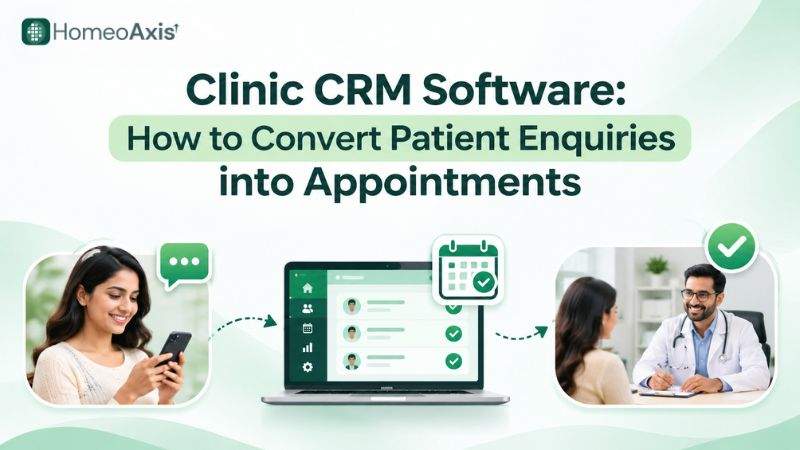
Clinic CRM software helps clinics convert patient enquiries into appointments by recording leads, assigning staff, tracking communication and managing follow-ups. It connects prospective patients with appointment scheduling and helps clinics measure bookings and attendance.
For homeopathy clinics, it also supports first-consultation enquiries, repeat appointments and chronic-care follow-up coordination.
What Is Clinic CRM Software?
Clinic CRM software is a digital system that manages prospective patient enquiries and communication throughout the appointment booking process. It records contact details, enquiry sources, follow-up activities and conversion status.
In healthcare, CRM stands for Customer Relationship Management. Its purpose is to help clinics maintain relationships with prospective patients and manage administrative communication.
A healthcare CRM typically supports:
Capturing enquiries from websites, advertisements and clinic profiles.
Recording patient contact details and consultation requirements.
Tracking communication and follow-up activities.
Assigning enquiries to responsible staff members.
Converting enquiries into patient records.
Connecting enquiries with appointment scheduling.
For example, when someone enquires about a first homeopathy consultation through a clinic website, the receptionist can record the enquiry, share consultation details, follow up and book an available appointment.
This creates a traceable process instead of treating every enquiry as a separate phone call or message.
Why Do Clinics Lose Patient Enquiries Before Booking Appointments?
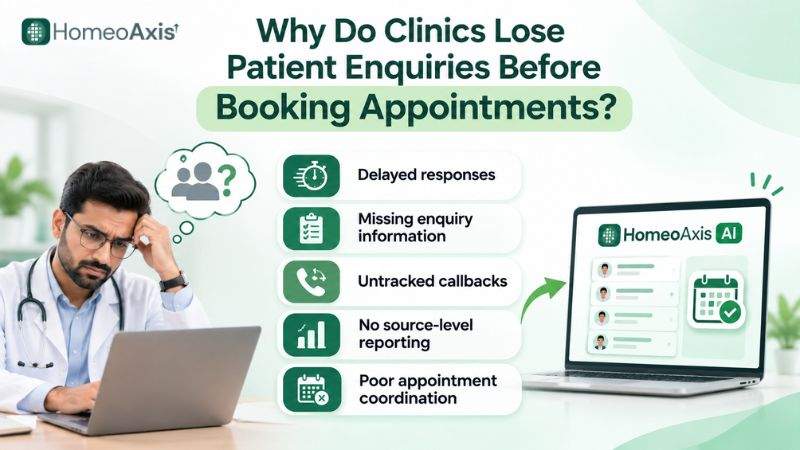
Clinics lose enquiries mainly because communication is fragmented, follow-ups are delayed and staff cannot identify who is responsible for the next action.
Common problems include:
1. Delayed responses: Prospective patients may contact another clinic if they do not receive timely information.
2. Missing enquiry information: Staff may forget to record where an enquiry originated or what consultation information the person requested.
3. Untracked callbacks: Someone asking about a consultation may want to speak again after a few days. Without a recorded follow-up, the conversation can be forgotten.
4. No source-level reporting: Clinics often cannot compare enquiries from Google Business Profile, website forms, referrals and paid advertisements.
5. Poor appointment coordination: Staff may need to check doctor availability separately before confirming a consultation.
A lead follow-up system addresses these problems by recording each enquiry, its communication history and the next required action.
How Does Clinic CRM Software Convert Patient Enquiries into Appointments?
An effective enquiry management process has six steps: capture, respond, assign, follow up, convert and measure. Each step helps clinic teams move from an incoming enquiry to a confirmed appointment and evaluate the results.
1. Capture Enquiries from Different Sources
The first step is recording every incoming enquiry and identifying where it originated.
Homeopathy clinics commonly receive enquiries through:
Clinic websites and enquiry forms.
Google Business Profile and clinic profiles.
Google and Meta advertisements.
Phone calls and direct communication.
Existing patient referrals.
Each enquiry should include the person's name, contact details, enquiry date, source and consultation requirement.
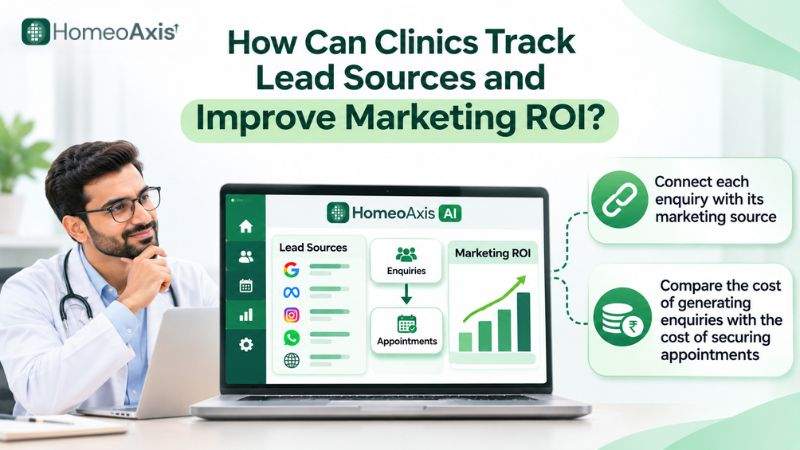
Recording the source allows clinic owners to compare marketing channels and identify which ones generate actual appointments.
HomeoAxis supports lead capture through website forms, clinic profiles and webhook-based integrations for Google and Meta advertising leads. These enquiries enter its built-in CRM pipeline for tracking and conversion.
2. Respond Quickly and Understand the Consultation Requirement
The next step is contacting the prospective patient and understanding what information they need before booking.
A practical internal target is to acknowledge new enquiries within 15 minutes during clinic working hours. This is a suggested operational target, not an established healthcare industry standard.
The importance of timely responses is also reflected in InsideSales' 2021 Lead Response Research. The study examined more than 55 million sales activities involving 5.7 million inbound leads across 400+ companies. It reported that conversion rates were more than eight times higher when the first contact attempt occurred within five minutes rather than after five minutes to 24 hours.
InsideSales, also known as XANT in some company references, conducted this research in a general sales context. It is not a healthcare-specific conversion benchmark. However, it highlights why clinics should avoid leaving new enquiries unattended.
For homeopathy clinics, the initial conversation should establish whether the person wants a first consultation, an appointment for an existing patient or information about clinic timings.
Example WhatsApp reply:
Hello [Name], thank you for contacting [Clinic Name]. We have received your consultation enquiry. Our team can help you with available appointment timings and the booking process. Please let us know your preferred day and time.
Staff should avoid requesting unnecessary medical information through an initial marketing or enquiry conversation.
3. Assign Each Enquiry to One Responsible Person
Every enquiry should have a designated owner who is responsible for the next action.
For example, a receptionist may handle new enquiries, while a clinic coordinator manages pending callbacks and appointment confirmations.
This prevents two staff members from contacting the same prospective patient unnecessarily and reduces the possibility of enquiries being overlooked.
For multi-location clinics, managers should also establish branch-wise responsibilities so that enquiries reach the correct clinic team.
4. Follow Up and Reactivate Inactive Enquiries
Not every prospective patient books immediately. Some need time to check their availability, discuss the consultation with family members or understand the clinic's services.
Staff should record the next contact date and the outcome of each conversation. A CRM pipeline can show whether an enquiry is new, contacted or awaiting follow-up. The next action and its due date should remain visible to the responsible staff member.
For example:
Day 1: A person enquires about a first consultation.
Day 1: Reception shares consultation timings.
Day 2: The person requests a callback.
Day 3: Reception contacts the person as agreed.
Day 3: The person confirms an available appointment.
Clinics should also review older enquiries that did not convert.
Enquiry reactivation means contacting a previously interested person who did not book, provided the clinic has an appropriate basis and permission to contact them.
A polite message could be:
Hello [Name], you previously contacted [Clinic Name] regarding a consultation. If you still need assistance with appointment availability, our team will be happy to help. Please let us know if you would like us to contact you.
Do not repeatedly message people who have declined further communication.
5. Convert Enquiries into Appointments
Once someone agrees to consult, the next step is checking doctor availability and confirming the appointment.
For a homeopathy clinic, this may involve selecting the consultation type, doctor, available time slot and appointment duration.
The receptionist should confirm:
Doctor's name.
Consultation date and time.
Clinic address or online consultation details.
Necessary booking instructions.
After confirmation, the enquiry should be converted into a patient record and linked to the appointment.
6. Measure Appointment Conversion and Attendance
Clinics should measure both appointment conversion and attendance. These figures help owners understand how effectively their teams handle enquiries and how many confirmed bookings result in consultations.
Enquiry-to-Appointment Conversion Rate
Conversion Rate = (Confirmed Appointments ÷ Total Enquiries) × 100
Appointment Show Rate
Show Rate = (Attended Appointments ÷ Confirmed Appointments) × 100
For example, if a clinic receives 100 enquiries, confirms 30 appointments and records 24 attended consultations:
Enquiry-to-appointment conversion rate: 30%.
Appointment show rate: 80%.
These are illustrative figures, not industry benchmarks.
Tracking both metrics helps clinic owners understand whether they need to improve enquiry handling or appointment attendance.
How Can Clinics Track Lead Sources and Improve Marketing ROI?
Clinics should connect each enquiry with its original marketing source and compare the cost of generating enquiries with the cost of securing appointments.
For example:
Lead Source | Enquiries | Appointments | Conversion Rate |
Google Ads | 50 | 15 | 30% |
Meta Ads | 40 | 8 | 20% |
Google Business Profile | 30 | 12 | 40% |
Patient Referrals | 20 | 10 | 50% |
Illustrative data only.
A useful additional metric is:
Cost per Booked Appointment = Advertising Spend ÷ Appointments Attributed to That Source
Clinics should also calculate the cost per attended consultation for a more accurate assessment.
A manager dashboard should bring together enquiry volume, pending follow-ups, confirmed bookings, attendance and source-level performance.
How Does Clinic Workflow Automation Improve Patient Communication?
Clinic workflow automation handles repetitive administrative activities while allowing staff to manage conversations that need personal attention.
Useful automation opportunities include:
Sending appointment confirmations after booking.
Sending reminders before scheduled consultations.
Recording incoming enquiries in the CRM.
Notifying staff when a new lead arrives.
Creating follow-up reminders.
Recording appointment cancellations and rescheduling.
Sending appropriate post-consultation notifications.
For homeopathy practices, these processes are particularly useful for chronic-care follow-up scheduling and repeat consultation coordination.
What Should Clinics Know About WhatsApp Messaging?
Clinics using the WhatsApp Business Platform must follow its messaging rules.
Obtain appropriate permission before sending business-initiated messages.
Within the 24-hour customer service window after a patient's message, businesses can respond using permitted free-form messages.
Outside this window, business-initiated messages must use approved message templates.
When using automation, provide a clear way for patients to reach human support.
Avoid including diagnoses, prescriptions or unnecessary health information in routine reminders.
Example appointment confirmation:
Hello [Patient Name], your appointment with [Doctor Name] at [Clinic Name] is confirmed for [Date] at [Time]. Please contact us if you need to reschedule. Thank you.
Refer to the official WhatsApp Business Policy for current requirements. You can also review the HomeoAxis WhatsApp features for clinics.
What Should Doctors Look for in Clinic CRM Software?
Doctors should evaluate whether the software supports their actual enquiry and appointment workflow.
Requirement | Why It Matters |
Lead source tracking | Identifies where enquiries originate |
Enquiry pipeline | Shows the current status of each lead |
Staff assignment | Establishes responsibility for follow-ups |
Follow-up management | Prevents agreed callbacks from being missed |
Lead-to-patient conversion | Connects enquiries with patient records |
Appointment scheduling | Simplifies booking |
Communication tools | Supports patient contact |
Reporting dashboard | Measures conversion and attendance |
Data access controls | Helps protect patient information |
For homeopathy doctors, homeopathy clinic software should also support patient case histories, consultation records, prescriptions and ongoing follow-up management. Review the HomeoAxis clinic management features to see how these workflows can work together.
How Can Clinics Protect Patient Information?
Clinics should select software with appropriate access controls and transparent data-handling practices because enquiry records can contain personal information.
Before choosing a platform, check:
Whether staff access can be restricted according to their responsibilities.
Whether patient records are protected against unauthorised access.
Whether the provider explains data storage, backups and retention.
Whether the clinic can export records when required.
Whether patient information is used only for appropriate, disclosed purposes.
In India, clinics should review the Digital Personal Data Protection Act, 2023 and the Digital Personal Data Protection Rules, 2025. The rules were notified on 13 November 2025 and have phased commencement dates:
Rules 1, 2 and 17–21 came into force on 13 November 2025.
Rule 4, which concerns the registration and obligations of Consent Managers, is due to commence on 13 November 2026. It concerns Consent Managers and is not itself a direct registration requirement for clinics.
Rules 3, 5–16, 22 and 23 are due to commence on 13 May 2027. These provisions include requirements relevant to notices, consent, security safeguards and personal data breach reporting.
In practical terms, clinics handling personal data should prepare to meet the applicable notice, consent, security and breach-reporting duties as the relevant provisions take effect. Check the latest official notifications and the provisions applicable to your clinic before making compliance decisions.
Read the official MeitY DPDP Rules and enforcement notifications and the Gazette notification dated 13 November 2025.
This is general information, not legal advice. Consult a qualified legal or data-protection professional about your clinic's specific obligations.
What Should Clinics Implement During the First Week of Using a CRM?
Clinics can start with a small, manageable setup instead of trying to automate every process immediately.
Day | Implementation Task |
Day 1 | Add enquiry sources and define the information staff must record. |
Day 2 | Set up the enquiry pipeline and assign staff responsibilities. |
Day 3 | Add follow-up reminders and agree on response-time targets. |
Day 4 | Prepare approved communication templates and appointment messages. |
Day 5 | Connect supported enquiry forms and advertising lead sources. |
Day 6 | Test the process using sample enquiries and appointment bookings. |
Day 7 | Review pending leads, conversion figures and staff feedback. |
After the first week, clinic managers should review the pipeline regularly and adjust responsibilities or follow-up procedures where needed.
Common Mistakes Clinics Should Avoid When Managing Patient Enquiries
Even with CRM software, poor processes can affect appointment conversion. Clinics should avoid these common mistakes:
Recording enquiries without identifying their source.
Contacting prospective patients without checking previous communication.
Leaving follow-ups without an assigned responsible person.
Ignoring older enquiries that may still be interested.
Treating a confirmed appointment as an attended consultation.
Sending WhatsApp messages without following permission and template requirements.
Giving staff unrestricted access to patient information.
Measuring marketing success only by the number of enquiries.
A consistent enquiry management process is essential for getting meaningful results from clinic CRM software.
How Does HomeoAxis Help Convert Patient Enquiries into Appointments?
HomeoAxis is a homeopathy clinic management platform that combines lead management, patient records and appointment scheduling.
Its lead and CRM features include:
Lead Capture: Collect enquiries through website forms, clinic profiles and supported Google and Meta advertising lead-form integrations.
Lead Pipeline: Track enquiries through New, Contacted, Follow-up and Converted stages. Follow-up reminders help staff identify enquiries that need another contact attempt.
Communication: Contact prospective patients through one-click calling, WhatsApp and SMS options, with activity logged automatically against the lead.
Lead-to-Patient Conversion: Convert a qualified lead into a full patient record in one click, with duplicate-patient protection.
Appointment Management: Book the first appointment after converting a qualified lead and manage consultation and follow-up appointments.
WhatsApp Notifications: Support appointment-related notifications and reminders.
These capabilities connect patient acquisition with everyday clinic operations.
Explore HomeoAxis to understand how the platform may fit your clinic's enquiry and appointment workflow.
Conclusion
Converting patient enquiries into appointments requires timely communication, clear staff responsibilities, proper follow-ups and reliable appointment coordination.
Clinic CRM software brings these activities together so that clinics can track enquiries, identify pending actions and measure booking performance.
For homeopathy doctors, connecting enquiry management with patient records, chronic-care follow-ups and appointment scheduling makes the entire process easier to manage.
This article provides administrative and software guidance, not medical advice.
Frequently Asked Questions
1. What is the main purpose of clinic CRM software?
Its main purpose is to manage prospective patient enquiries, communication and follow-ups so that clinics can convert interested people into confirmed appointments.
2. What is a reasonable response-time target for clinic enquiries?
A 15-minute acknowledgement target during clinic working hours is a practical starting point. It is an internal service recommendation, not a healthcare industry standard. Clinics can adjust the target according to their staffing and working hours. The 2021 InsideSales research also highlights the value of prompt responses, although its findings relate to general sales activities rather than healthcare.
3. How much does clinic CRM software cost?
The cost depends on the number of clinics, staff users, integrations and features included in the plan. Some platforms offer lead-management features separately, while others include CRM as part of a broader clinic management system.
HomeoAxis provides multiple plans with different clinic capacities and feature access. Its pricing page displays current plan details and monthly equivalents for plans billed annually. Check the HomeoAxis pricing page for current prices, plan features and billing terms before choosing a plan.
4. Can clinic CRM software reduce missed appointments?
Clinic CRM software can help reduce missed appointments by making it easier to schedule follow-ups, send reminders and keep patients informed. However, CRM software alone does not guarantee fewer missed appointments.
A 2018 systematic review by Dantas and colleagues analysed 105 studies and reported an average no-show rate of approximately 23% across the reviewed settings. The review also identified longer appointment lead times and a history of previous missed appointments among the commonly reported significant factors associated with no-shows. This suggests that clinics should pay attention to how far in advance appointments are booked and whether patients have previously missed appointments. The 23% figure is a broad research finding, not a benchmark for Indian homeopathy clinics. Read the Dantas et al. systematic review.
There is also direct evidence that appointment reminders can improve attendance. A 2013 Cochrane review included eight randomised controlled trials involving 6,615 participants. It found that mobile text-message reminders improved attendance compared with no reminders (risk ratio 1.14; 95% confidence interval 1.03–1.26), based on seven studies involving 5,841 participants. The evidence was rated moderate quality. This indicates a relative improvement in attendance, not a guaranteed 14-percentage-point increase for every clinic. Read the Cochrane review on mobile phone messaging reminders.
A separate 2024 systematic review examined open-access scheduling in outpatient clinics. Of the 16 studies included, 10 reported a significant reduction in no-shows, four found no significant reduction and two found no significant change. These findings relate to appointment scheduling policies, not CRM software or reminders. Read the 2024 open-access scheduling review.
5. Can clinics manage patient enquiries through WhatsApp CRM?
Yes. Clinics can use supported WhatsApp integrations to communicate with prospective patients, coordinate bookings and send appointment-related messages. Business-initiated messages outside the 24-hour customer service window require approved templates under the WhatsApp Business Platform rules.
6. Does CRM software replace reception staff?
No. CRM software supports reception staff by recording enquiries, organising callbacks and coordinating appointments. Staff remain responsible for understanding patient requirements, answering questions and handling requests that need personal attention.
7. Can clinic CRM software track Google and Meta advertising leads?
Yes, when the platform supports the required integrations. HomeoAxis supports webhook-based capture of supported Google and Meta advertising lead forms, allowing those enquiries to enter its CRM pipeline.
8. Is clinic CRM software useful for homeopathy clinics?
Yes. It helps homeopathy clinics manage first-consultation enquiries, appointment bookings, follow-up communication and patient conversion. An integrated platform also connects these activities with case histories and ongoing patient management.
Author Bio
Prashant Singh is the CTO and a software expert at HomeoAxis. He works on software solutions designed to support homeopathy clinic management, patient administration and digital practice workflows.